
A faster irrigation-boom pass applies less nominal water per unit area when active flow and strip width stay unchanged. The speed display alone cannot describe an irrigation event: you also need to know which nozzles are active, where they water and whether the return pass waters the same strip.
Compare the proposed program by its moving application, then keep that calculation separate from measured distribution and crop response. A nominal emitted depth is not a measured dose retained by every pot.
Follow one steady pass across its strip
For a straight, uninterrupted pass, let Q be the active nozzle group's total flow in litres per minute, W its corresponding strip width in metres, and v the travel speed in metres per minute. In one minute, the boom covers W × v square metres and emits Q litres.
Nominal emitted water per steady pass = Q ÷ (W × v), in L/m². This assumes constant flow, constant speed and the stated active width. It averages emission across that strip; it does not prove even collection across its width.
UMass describes moving nozzles, variable-speed drives, nozzle-pattern overlap and controls that can select sections or repeat passes in its boom-irrigation guidance. Those features explain why the active group and its path belong beside the arithmetic. Its historical prices and operating examples are not settings for a new installation.
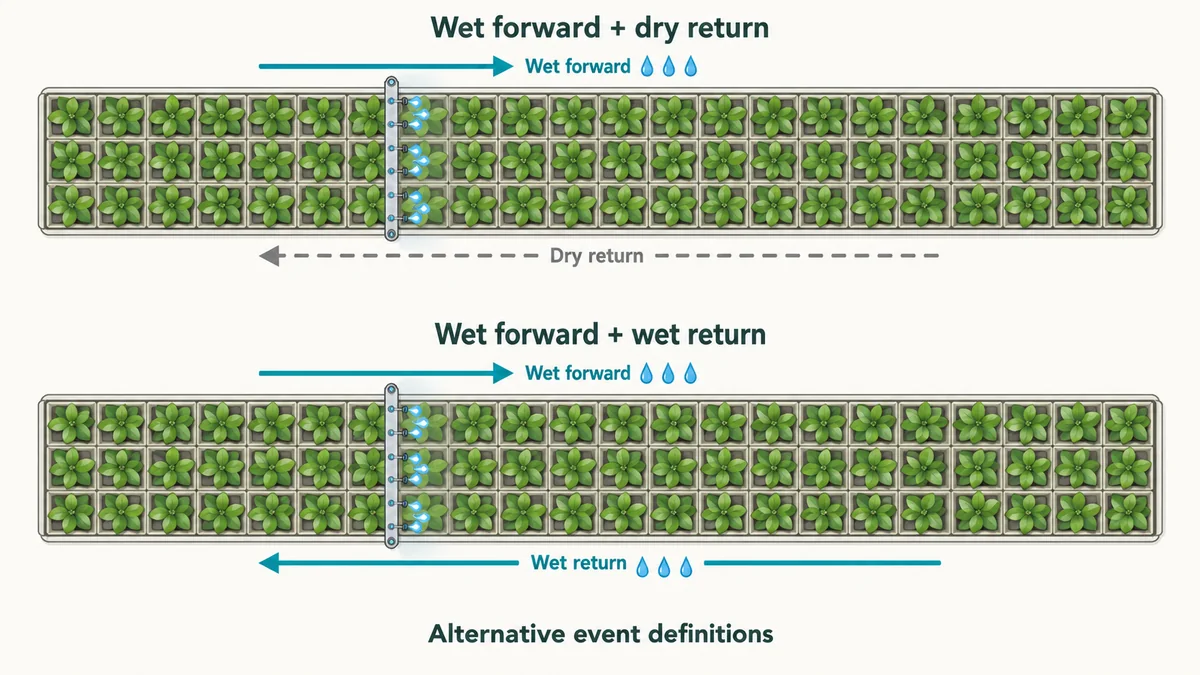
Compare speed and return mode with one example
The following numbers are invented for arithmetic, not recommended irrigation settings. Assume 6 L/min emitted over a 2 m strip at a constant 3 m/min. One steady pass gives 6 ÷ (2 × 3) = 1 L/m². Doubling only speed to 6 m/min gives 0.5 L/m².
| Illustrative event | Active water passes over the same strip | Nominal total |
|---|---|---|
| Forward at 3 m/min; dry return | One | 1 L/m² |
| Forward and return both water at 3 m/min | Two identical steady passes | 2 L/m² |
| Forward at 6 m/min; dry return | One | 0.5 L/m² |
A grower who changes the return from dry to watering has changed the event even if the forward-speed display is unchanged. If the two directions use different flows, speeds or active sections, calculate them separately rather than multiplying one pass by two.
This distinction exists in real offers. AdeptAg's dual-rail boom description lists variable travel speed, zone programming and forward-only or two-direction irrigation. These are features of that offered architecture, not proof that every boom has them or that its advertised uniformity will occur in another greenhouse.
Keep boundary behaviour outside the steady-pass answer
The equation uses travel speed in its denominator. It cannot describe a stop by pretending zero speed is a valid steady pass. Acceleration, deceleration, turnarounds and any delay with water active require their own OEM explanation and commissioning review.
Use an unscaled path sketch to identify the constant-speed section, active nozzle width, skipped areas and boundary strips. If only part of the nozzle assembly is active, the stated Q and W must describe that same part. Combining the whole-boom flow with a smaller strip width creates a different and misleading quantity.
Travel distance helps define the segment being discussed. For an otherwise identical steady segment, doubling distance doubles both emitted volume and covered area, so the nominal depth is unchanged. That does not make start and end behaviour disappear.
Separate emission, collection and root-zone response
A useful commissioning discussion has three records. The first is the nominal emitted amount from documented flow and motion. The second is observed distribution from the qualified commissioning plan. The third is the crop/root-zone response, which also depends on interception and what reaches and remains in each container.
Do not erase a poor boundary pattern by averaging it into a long straight run. Likewise, a correct nominal calculation cannot establish that every root plug received the intended amount. Ask the OEM to explain the event definition and the commissioning specialist to identify the observations needed for the actual crop arrangement.
Download the pass-to-area worksheet
Download the boom pass-to-area worksheet (CSV). It contains formulas for the steady-pass arithmetic and manual evidence fields. Import as UTF-8, comma-separated text with formula evaluation enabled. Keep the row order unchanged. Enter numeric values only in the blank “Your case” input cells; do not overwrite calculated rows. The example column is fictional. Record actual path and boundary questions in the manual fields, adjust wrapping and save a native spreadsheet copy.
The next purchasing step is a program description that identifies each watered pass and its active strip. It should not depend on a single speed value or become a crop-watering schedule. For the broader facility arrangement, see nursery design around propagation flow.