
An infrared reading aimed toward a crop is not necessarily a leaf-temperature reading. The instrument may also see growing media, a floor, support hardware or gaps between plants. Before using the result to discuss crop stress, establish what surface area contributed to it.
The practical question is simple: does the measurement represent the leaves you intended to observe? Answer it using the instrument's field-of-view definition, viewing distance and angle, crop coverage and an unobstructed measurement path. Keep crop interpretation separate until that measurement basis is clear.
The aiming point is not the measurement footprint
A visible spot helps an operator aim some handheld instruments. It should not be assumed to outline the whole measured area. The Fluke 65 manual, for example, explicitly distinguishes its laser spot from its measured spot. Use the instructions for the actual instrument rather than transferring that model's optical dimensions.
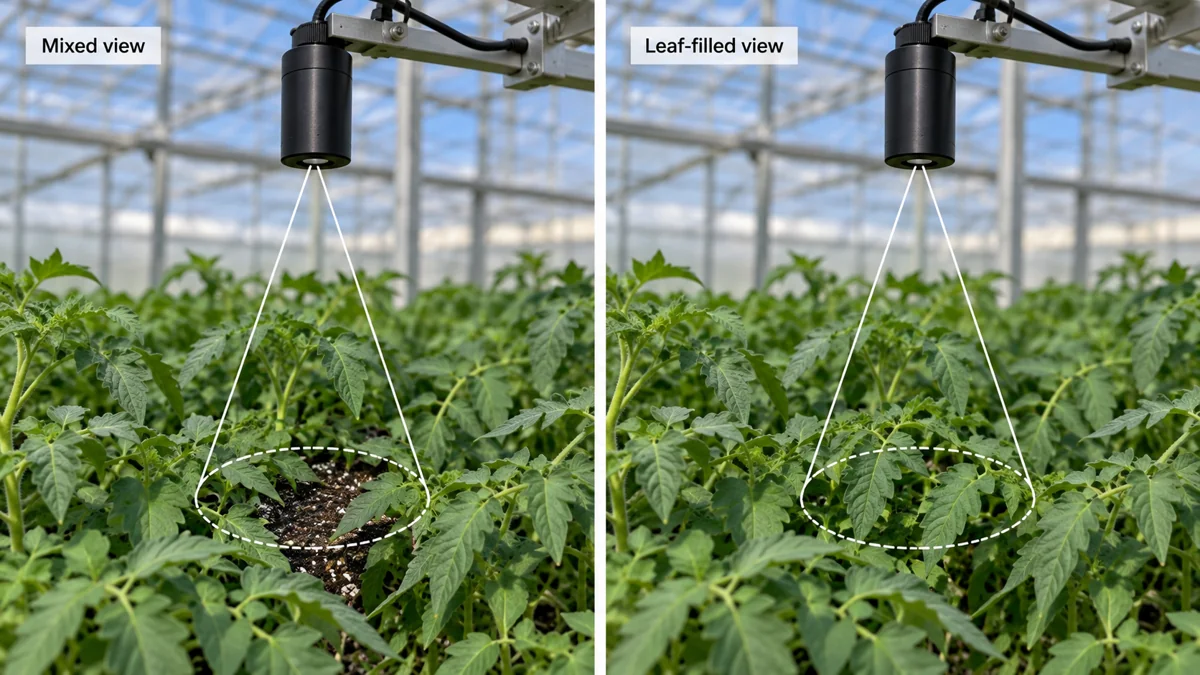
For a fixed infrared radiometer, identify how the manufacturer defines field of view. Apogee's field-of-view explanation uses a half-angle and a defined proportion of detected radiation. It also describes the center-weighted response of the target area. That definition should not be treated as a universal boundary for every infrared instrument.
Record the model and the applicable optical specification before sketching the footprint. A generic cone drawn over a crop is useful for discussion, but it is not a substitute for the instrument's geometry.
Distance and angle change what enters the reading
Apogee's infrared-radiometer calculators use viewing height, angle and sensor selection to estimate the target area for supported models. Tilting the view changes its shape and extent. A view that appears to point into a crop row can include more background than expected.
For your record, sketch where the sensor sits, the direction it points and the crop surface it is intended to observe. Include the distance to that surface and the viewing angle using the manufacturer's convention. Do not mix a full viewing angle with a half-angle.
If plant height changes, revisit the geometry. The instrument can remain fixed while the distance to the crop and the surfaces in view change. A continuous temperature trend may therefore need a note identifying when the crop coverage became materially different.
Separate a leaf target from a mixed canopy target
A young canopy often leaves visible gaps. Apogee's canopy-fraction discussion explains why an infrared radiometer viewing both vegetation and soil produces a mixed reading. This is particularly relevant when the target does not completely fill the field of view.
Choose what you intend to report: an individual leaf surface, a defined canopy area or a mixed scene. Then check whether the instrument and setup can support that description. Do not label a mixed canopy-and-background value as the temperature of a particular leaf.
A normal photograph taken from a documented viewpoint can help record visible crop coverage. It does not measure temperature or automatically match the infrared instrument's footprint. Mark the relationship and its limitations instead of using a photograph as proof of exact canopy fraction.
Check the path to the surface
Do not assume that a transparent greenhouse material is transparent in the instrument's infrared band. The Fluke manual cited above warns that an intervening glass surface can become the surface being measured. For measurements through any cover or window, obtain explicit guidance for the instrument, material and spectral band.
Prefer a documented direct view where the operating arrangement allows it safely. Record any obstruction, moisture on the target, spray event or condition affecting the view. Never remove a guard, climb onto unsafe access or direct a laser toward people to obtain a reading.
Emissivity settings and reflected radiation also need the maker's guidance. Preserve the setting used and its basis. This article provides no universal emissivity value or correction that applies to every leaf, viewing condition and instrument.
Keep the observation record with the temperature
| Field | Record | Evidence or limitation |
|---|---|---|
| Question and intended target | ________ | Leaf, canopy area or mixed scene |
| Instrument model, serial number and manual | ________ | ________ |
| Spectral band and field-of-view definition | ________ | ________ |
| Distance, angle and footprint estimate | ________ | Manufacturer convention and method |
| Crop coverage and background surfaces | ________ | Observation or documented estimate |
| Crop, stage, leaf position and location | ________ | ________ |
| Direct view or intervening material | ________ | ________ |
| Surface condition and recent irrigation or spraying | ________ | ________ |
| Emissivity setting and its approved basis | ________ | ________ |
| Time, weather and greenhouse operating state | ________ | ________ |
| Infrared reading and instrument check status | ________ | ________ |
| Reference air reading, location and time | ________ | ________ |
| Repeated locations and interpretation limits | ________ | ________ |
Keep air temperature as a separate measurement. A reference air sensor helps describe the conditions around the observation, but agreement with it does not by itself validate the infrared surface reading. The two instruments measure different things.
Decide whether the reading is ready for interpretation
If the footprint includes substantial uncharacterized background, label the result as mixed and review the setup. If an intervening material has unknown infrared behavior, leave the crop temperature unresolved. If the target and method are documented, provide the record to the crop adviser with repeated observations at relevant locations.
A thermal image's color scale is not a diagnosis. Keep the numerical scale, instrument settings and scene context with it, and do not issue an irrigation command from color alone. Operational thresholds require an appropriate crop-specific basis.
The broader climate-sensor placement and calibration checklist supports the reference measurements around this work. The distinct task here is to establish which surfaces the infrared instrument actually sees. Once that is clear, the grower has a much stronger basis for asking what the temperature means.
Download the working files
Use these CSV files with the instructions in this article.