
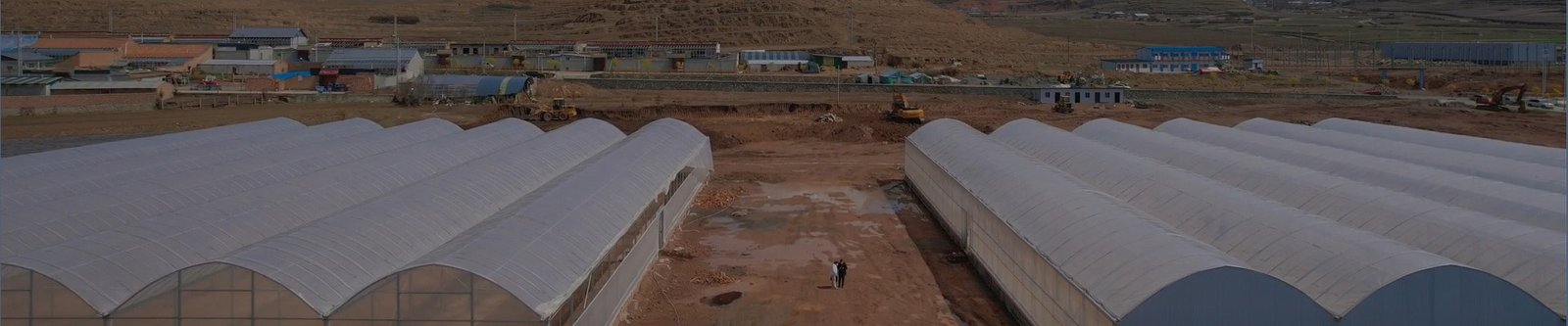
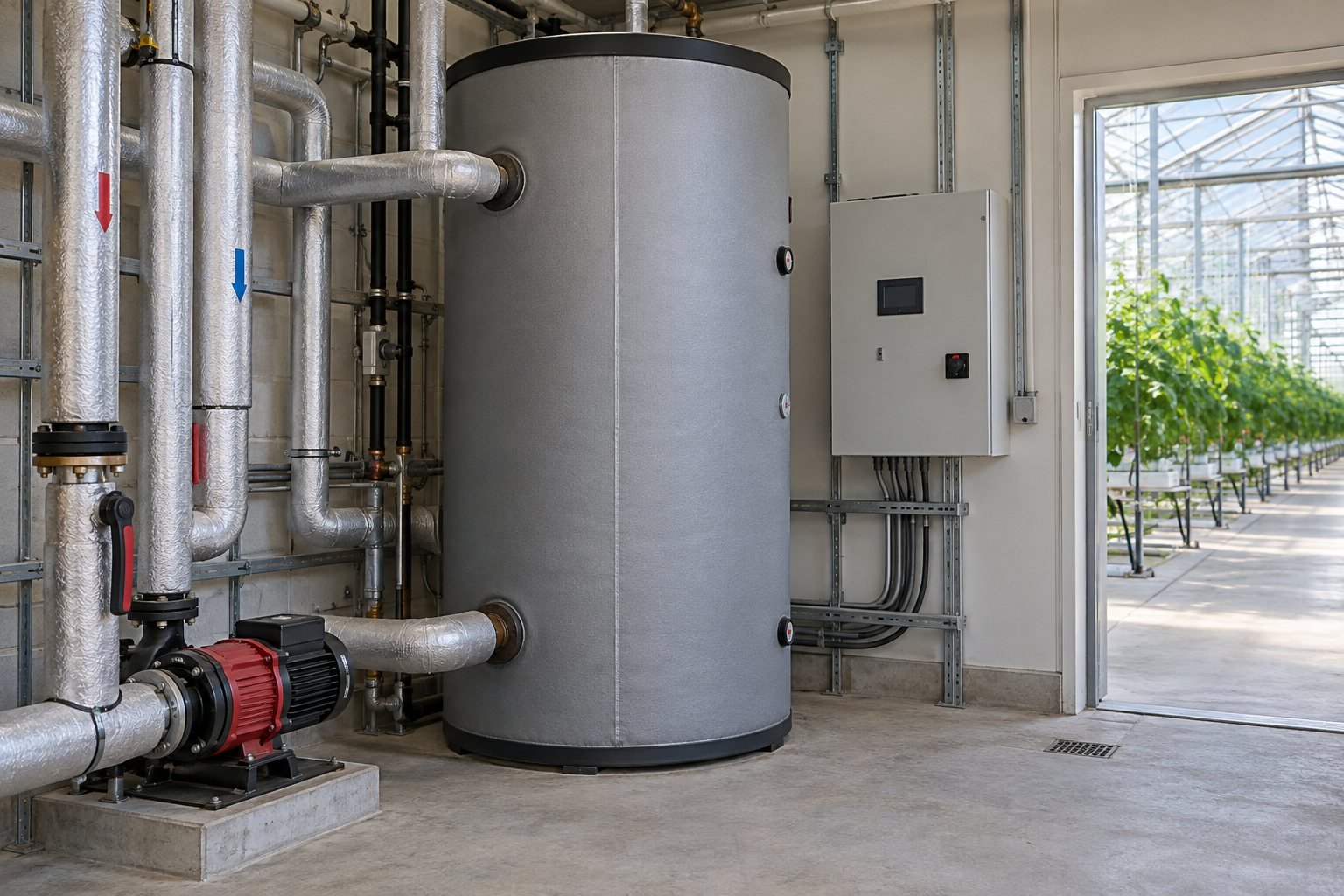
A large hot-water tank looks reassuring on a heating proposal. Yet a tank that holds several cubic meters may support the greenhouse for only minutes at peak demand. Its useful contribution depends on the temperature range the heating system can actually use.
A buffer tank stores sensible heat in water. It does not create heat or permanently increase boiler output. Calculate usable energy, discharge power and recharge conditions separately before deciding whether the tank solves cycling, short interruptions or a planned shift in heating time.
Calculate energy from volume and usable temperature drop
For water near normal heating-system conditions, an approximate planning equation is:
Stored heat in kWh = water volume in liters x 0.001163 x usable temperature difference in degrees Celsius.
The coefficient follows from water's approximate density and specific heat. It is a first-pass energy balance, not a pressure-vessel design or a guarantee of delivered heat. Glycol mixtures and operating temperatures require the appropriate fluid properties.
Hypothetical example: 5,000 L of water with a usable 20 C temperature drop stores about 116.3 kWh before losses and delivery limitations. At a constant 200 kW net draw, that energy corresponds to 0.58 hours, or about 35 minutes. If only a 5 C drop is usable, the same tank provides about 29.1 kWh, roughly nine minutes at that draw.
The emitter determines how much temperature drop is usable
If the greenhouse heating pipes need a minimum supply temperature to meet the load, energy below that level cannot be counted as available at that duty. Stratification, mixing, sensor locations and hydraulic connections also affect the temperature delivered to the crop circuit.
| Parameter | Ask the designer to define | Common overstatement |
|---|---|---|
| Effective water volume | Volume participating in the intended cycle | Counting every nameplate liter as equally usable |
| Upper and lower temperatures | Safe source limit and minimum useful emitter supply | Using a large temperature difference the crop circuit cannot exploit |
| Discharge power | Flow and heat-transfer capacity through the actual circuit | Assuming stored energy can be released at any rate |
| Recharge margin | Heat-source output remaining after simultaneous crop demand | Assuming a fully loaded boiler can also recharge storage |
Separate cycling control from energy savings
A buffer can allow longer operating cycles for a heat source that otherwise starts and stops frequently. That does not establish an economic saving in every installation. A DOE-supported study of residential hydronic systems found reduced cycling with a buffer arrangement but did not establish a significant operating-cost advantage for that comparison. It is residential evidence, not a greenhouse performance claim.
For a greenhouse, compare minimum heat-source output with small-zone demand, the intended control sequence and tank standby losses. A tank added to compensate for poor controls may be less useful than correcting those controls; the designer should evaluate both options.
Write down the load during the proposed storage period
Heating demand is not constant across a night. Use the greenhouse heating-load checklist to establish the design basis. For time-shifting, model the actual interval and charging opportunity, not just the coldest hour divided into the tank energy.
Keep the purpose explicit. A cycling buffer, a short-duration contingency store and a tariff-shifting store can require very different capacities and controls. None replaces an outage plan for pumps, controls and the heat source.
What to send for a project review
Give CFGET and the heating designer the load profile, heat-source performance, emitter temperatures, fluid specification and available space. Request the usable-kWh calculation, hydraulic schematic and a commissioning record of temperatures through a full charge and discharge cycle. Pressure rating, expansion allowance, relief protection and local compliance belong with qualified professionals. The purchasing decision should rest on a defined operating benefit, not on tank size alone.