
A heat-recovery percentage does not tell a greenhouse buyer how much crop moisture the ventilation stream removes. To answer that question, identify the air leaving the greenhouse, the replacement air delivered to it and the water vapour carried by each. Keep heat recovery and net moisture export as separate results.
Start with four named streams and a stated operating condition. If the proposal has only an efficiency percentage and a fan volume, the water balance is incomplete. A good review shows where each humidity value belongs and whether later mixing changes the air delivered to the crop.
Give every air stream a name
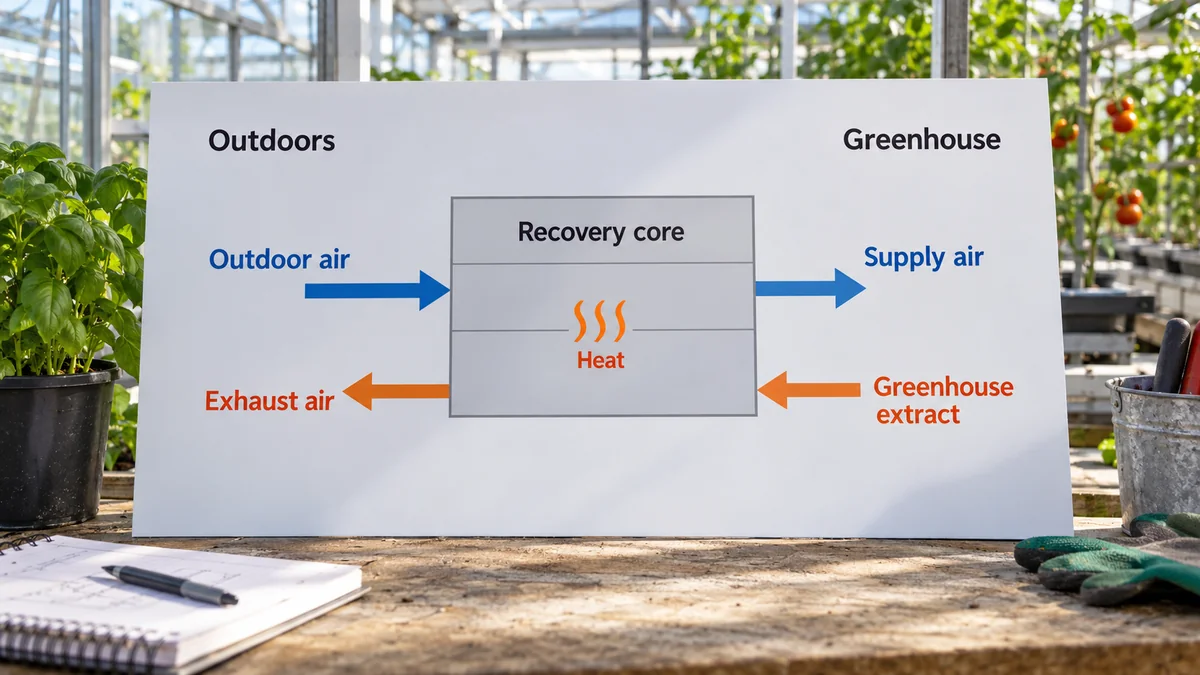
For a conceptual ventilation-recovery unit, label the boundaries before comparing measurements:
- Outdoor intake: outside air entering the recovery core.
- Supply from the core: air leaving the core toward the greenhouse.
- Greenhouse extract: greenhouse air entering the core on the outgoing path.
- Outdoor exhaust: air leaving the core to the outside.
These are four locations, not four interchangeable descriptions of “inlet humidity.” Record temperature, humidity ratio or enough temperature/relative-humidity/pressure evidence to establish it, dry-air flow and the operating state at the relevant boundaries. Keep bypass and frost-control states identifiable. Do not combine a normal-operation temperature with a flow taken in another mode.
Humidity ratio expresses water-vapour mass relative to dry-air mass. Relative humidity expresses a different relationship and changes with temperature. Two RH percentages measured at different temperatures cannot, by themselves, establish how much water the incoming and outgoing streams carry.
Work through a simple moisture balance
The following numbers are invented solely to explain the arithmetic. Assume steady operation, equal incoming and outgoing flow of 1,000 kg of dry air per hour, a single ventilation path, and no other exchange or storage in this simplified balance. Extract air carries 12 g of water vapour per kg of dry air.
| Hypothetical case | Delivered supply | Net ventilation moisture export |
|---|---|---|
| A | 6 g/kg dry air | 1,000 × (12 − 6) ÷ 1,000 = 6 kg water/h |
| B | 10 g/kg dry air | 1,000 × (12 − 10) ÷ 1,000 = 2 kg water/h |
The division by 1,000 converts grams to kilograms. The two cases have the same dry-air flow and extract humidity ratio, but different supply moisture. They export different amounts of water. A shared thermal-recovery percentage would not resolve that difference.
Neither result is an equipment rating or a recommended greenhouse airflow. Do not substitute 1,000 m³/h for 1,000 kg dry air/h. A volume-flow quotation needs the appropriate air-state and conversion basis before it can enter this equation. Similarly, replacing the supply humidity ratio with outdoor humidity assumes that the recovery and delivery process leaves it unchanged. That assumption needs evidence.
If supply and extract humidity ratios were equal under these same assumptions, this ventilation path would export no net water vapour. If supply were wetter, the signed result would show net moisture import. The sign matters; hiding a negative result as zero would conceal the condition the buyer needs to understand.
Separate recovered heat from transferred water vapour
The U.S. Department of Energy’s explanation distinguishes heat recovery from systems that also transfer water vapour. Its residential context is useful for the mechanism, not for selecting or sizing greenhouse equipment. Ask what the actual device transfers, under which air conditions, and how that affects delivered supply humidity.
There is another distinction: recovering latent heat does not necessarily mean returning the condensed water to the supply air. The English abstract of Wageningen’s 2016 greenhouse report GTB 1421 describes recovering latent energy by condensation and storing the recovered heat for later use. Water changing from vapour to liquid releases energy; that description does not require the liquid to become supply-air vapour. The abstract supports this principle. It is not a complete equipment specification.
Use the device data to answer the moisture-transfer question. A label such as sensible, enthalpy or latent recovery helps frame the discussion, but a percentage without its definition and test conditions is insufficient. Avoid a blanket conclusion that one recovery label is always suitable and another is always unsuitable for greenhouses.
Show downstream mixing as a separate boundary
AirGaïa’s EXT’AIR offering describes greenhouse ventilation with heat recovery and an air-mixing/distribution arrangement. This is a real example of why the core and the delivered crop-air stream may have different boundaries. The product page alone does not establish a moisture-impermeable core or independently validate a project’s moisture-removal result.
For a hypothetical proposal, suppose the core outlet has a humidity record but the distribution duct also receives recirculated greenhouse air. Ask for the mixing arrangement and the delivered-air condition. Do not count the entire mixed circulation flow as newly introduced outdoor air. Recirculated air has not crossed the greenhouse boundary simply because another fan moved it.
A qualified climate designer should reconcile leakage, unequal flows, condensate, mixing and any additional moisture-removal equipment. The simple balanced example above is deliberately smaller than that full design problem.
Turn the proposal into a reviewable record
Download the four-air-stream evidence record and the balanced-flow arithmetic worksheet. The stream record is a manual worksheet; the arithmetic CSV contains formulas, so open it in a spreadsheet with formulas enabled, keep the row order unchanged and fill only the blank inputs in “Your case”. Keep the four locations, operating state and evidence source together. In the worksheet, the two populated cases reproduce the explicitly hypothetical examples; a blank case is available only after confirming the same simplifying assumptions.
Record thermal recovery with its own definition, conditions and source. Record ventilation moisture export separately. If either result is missing, assign a specific evidence request instead of treating the other as a substitute.
For the wider project, connect this review to the hot- and humid-climate greenhouse design discussion. The purchasing decision is whether the stated air path supports the required moisture task at the stated conditions. A favorable heat-recovery figure answers only part of that question.