
Two filter elements carrying the same micron number should not be treated as equivalent until the number's meaning is clear. An opening dimension describes geometry. A retention result describes what happened to specified particles under a stated test. A replacement decision needs the second explanation as well as a compatible element.
Begin with the supplier's existing report. The useful question is: which particles were counted or weighed, and what fraction remained downstream? You do not need to introduce test material into greenhouse irrigation water to learn how to read that evidence.
Follow the particle path and define the result
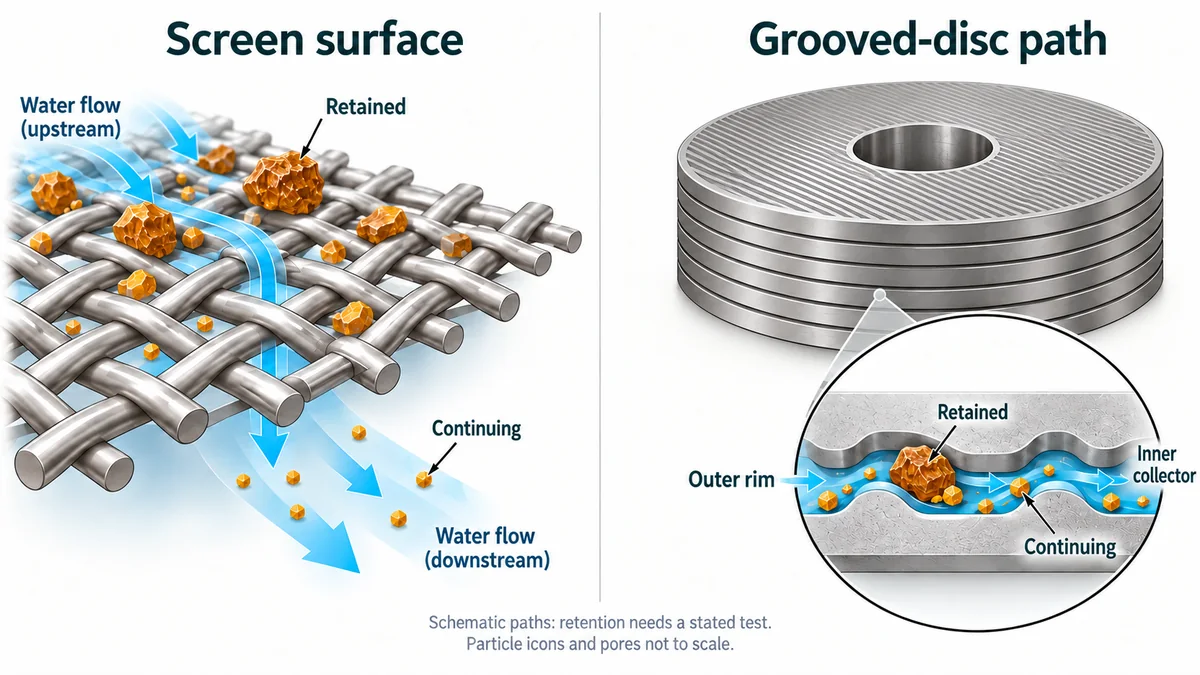
A regular woven screen presents openings between wires. Its mesh count describes openings per unit length, while its aperture describes clear space. Wire diameter changes that space, so mesh count alone cannot establish aperture. ScreenerKing's mesh explanation illustrates this geometric distinction for woven cloth; its screening chart is not an irrigation-performance conversion.
A grooved-disc assembly presents another arrangement. In Amiad's described disc technology, diagonally grooved discs are stacked and compressed so their intersecting grooves form multiple particle-retention channels. That explains a physical path, not a universal advantage over every screen. The element's actual design and its documented rating still matter.
A micron is a length unit. Attaching it to a filter does not, by itself, tell you the retained fraction, test material or operating condition. The short mesh explanation therefore belongs beside the rating interpretation, rather than replacing it.
Read nominal and absolute with their definitions attached
Pall's historical Principles of Filtration booklet distinguishes nominal, absolute and particle-count ratings. It also shows why test definitions and conditions matter. It is an industrial-fluid reference, not a current greenhouse irrigation standard.
| What the report gives | What to establish before comparing |
|---|---|
| Geometric opening | The actual opening dimension and geometry; no retained percentage is supplied by the length alone |
| Nominal retention | The manufacturer's retained fraction, particle-size boundary, count or mass basis, and test conditions |
| Absolute rating | The manufacturer's precise definition and referenced test; do not assign a universal percentage to the word |
| Particle-count result | The same size class or threshold, analyzed-volume basis and test conditions upstream and downstream |
Count and mass are different denominators. A result dominated by the mass of larger particles cannot be silently relabeled as the percentage of individual particles removed. Preserve the report's basis when transferring it into a comparison.
Work through two fictional reports
Suppose two reports concern the same stated particle-size class under the same defined test. Each count comes from the same analyzed volume, or has been normalized to the same volume. All numbers below are invented for interpretation, not acceptance criteria.
- Report A: 1,000 upstream and 100 downstream particles. Retained fraction = 1 − 100 / 1,000 = 0.90, or 90% by count.
- Report B: 1,000 upstream and 10 downstream particles. Retained fraction = 1 − 10 / 1,000 = 0.99, or 99% by count.
The shared micron label has hidden a meaningful difference in those fictional results. It has not established that either result suits a particular emitter. If one report instead concerns all particles above a threshold and the other only a narrow size band, stop the comparison and obtain matching definitions first.
Neither calculation predicts another particle shape, dissolved-ion removal, biological inactivation, installed bypass, pressure loss or service life. Even a well-defined element rating cannot establish that water in an installed assembly passes through the intended element and seals.
Turn the result into a replacement decision
Complete the sentence: “These two reports are comparable for this specified particle population and test basis.” If you cannot finish it with evidence, leave equivalence unresolved and ask the supplier for the missing definition. If you can, take the supported difference to the irrigation designer alongside the emitter requirement and installed assembly information. Broader system checks belong in the filtration and emitter-clogging guide.
Download the filter-rating interpretation worksheet. It combines guarded particle-count formulas with manual report interpretation. Import the UTF-8 comma-separated file with formula evaluation enabled, widen columns and wrap text, then save a native workbook copy. Enter only the blank Your case inputs and manual evidence fields. Keep row and column order; do not sort, insert or move rows. The example is fictional. Confirm matching particle, volume and test bases before entering the comparison confirmation; a calculated fraction is not an equipment approval.