
Before connecting a fertilizer injector, confirm which protective arrangement separates the source water from the chemical and crop circuits, who approved it, and how its condition will be verified. A component labeled “check valve” or “backflow valve” does not, by itself, answer those questions.
The arrangement must suit the actual water source, connected equipment, pressure conditions and local requirements. Ask the water authority where applicable and the qualified designer or plumbing professional to identify the required protection. A general greenhouse article cannot select an approved device for an unidentified site.
Which water must be protected from which connection?
Start at the source rather than at the injector catalogue. Record whether the system is supplied from a public main, private well, storage tank, recovered water system or a combination. Identify every connection the designer needs to review, including make-up water, chemical stock, crop distribution and return lines.
Backflow concerns water or other substances moving toward the supply instead of along the intended route. The University of Georgia's fertilizer-injector guidance explains the hazard associated with higher downstream pressure and discusses cross-connections. UMass explains how negative pressure in the supply can draw contaminated water back through a connection in its groundwater-protection guidance.
Those mechanisms matter even when the injector doses correctly during normal irrigation. Record the designer's assessment of supply interruption, pump shutdown, chemical-system pressure and other relevant operating states. Do not create a pressure reversal or disable protection to test an idea.
Describe the intended injected products accurately. A plan developed for one application should not silently acquire another chemical connection later. Give the designer the current product information and proposed uses, then have them confirm the implications for the protective arrangement.
Keep the authority question separate from the product question
The equipment supplier can explain a product's ratings and intended use. The local authority or appropriately qualified professional determines which requirements apply to the connection. Obtain both answers, and keep them tied to the same drawing revision.
UGA directs growers to local water authorities for current backflow requirements. UMass likewise tells growers on municipal supplies to check local rules, noting that some suppliers require a complete break in the water system. These are useful reasons to ask early. Their regional examples are not a worldwide installation specification.
Ask the following before an order is approved:
- Who has jurisdiction over this source connection, and which current requirement applies?
- What hazard and pressure conditions were considered when selecting the protection?
- Which exact arrangement, device model and installation conditions are approved?
- Who will install it, inspect it and perform any required testing?
- What records must be retained, and who sets the test or inspection interval?
- Which changes require the design or approval to be reviewed again?
Do not infer that a single check valve is sufficient everywhere, or that the same device is prohibited everywhere. Record the decision for this site. Where a supplier says local approval is the owner's responsibility, name the person who will obtain it and keep the release decision open until the evidence is available.
Build one protection record that survives handover
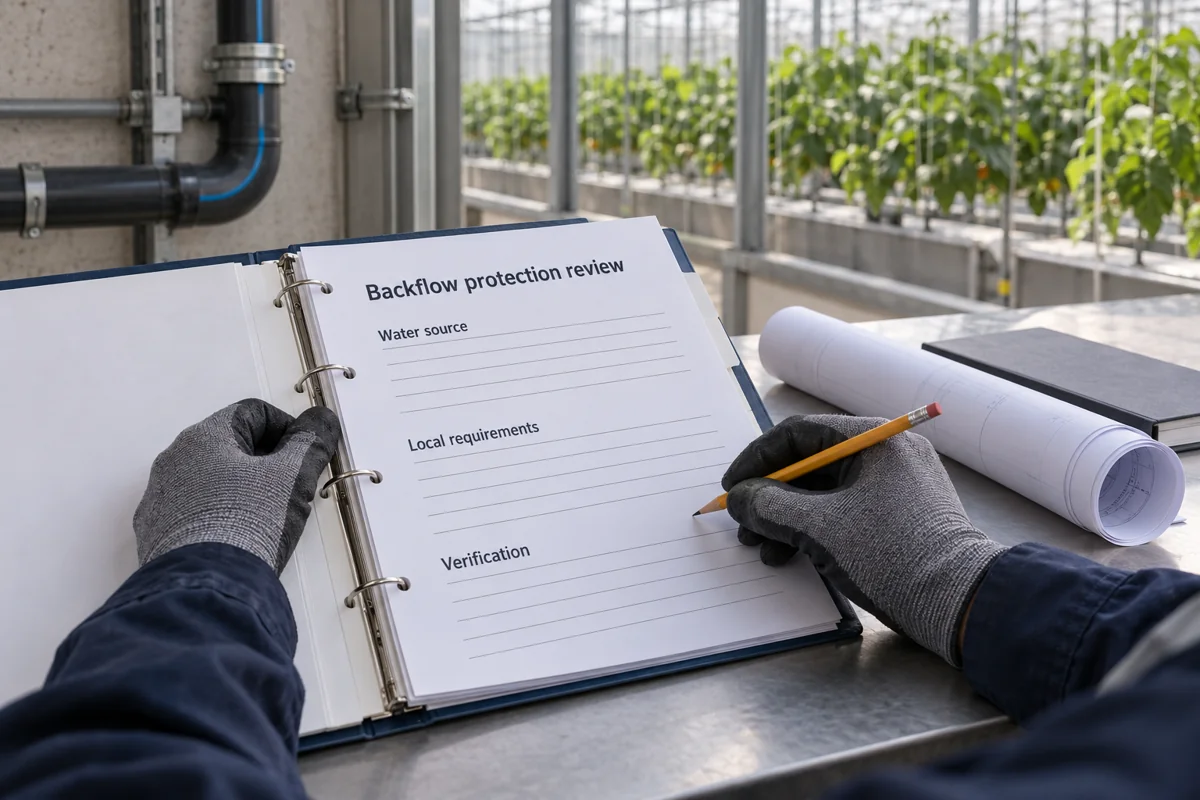
Download the fertigation source-protection review sheet. It is a documentation tool for a professional review, not a piping diagram. Attach the approved arrangement instead of drawing an improvised one from the checklist.
| Record | What must be identified |
|---|---|
| Source and authority | Source type, connection ID, responsible authority or professional, and applicable requirement reference |
| Intended use | Injected products, crop circuit and approved operating scope |
| Connections | Source, chemical, make-up and return connections on the reviewed drawing |
| Pressure review | Scenarios assessed by the designer and the document containing the assessment |
| Approved protection | Arrangement, exact model, rating evidence and drawing revision |
| Work ownership | Installer, inspector, tester and person authorized to release the connection |
| Verification | Required checks, completed record, date, next due action and unresolved deviations |
| Change control | Changes reviewed, approval reference and updated record location |
Use “not yet confirmed” for an unanswered field. A blank authority reference should not disappear when the purchase order is issued. Keep the model on the delivery document aligned with the model approved in the record; a substitution needs review, even if the supplier considers it an equivalent.
Make the record accessible to the people who operate and service the system. Retaining a certificate in an email inbox is less useful if no one can connect it to the installed device or discover when the next action is due.
What evidence supports permission to connect?
Ask for an explicit release decision based on the locally required documents and checks. Confirm that the installed arrangement matches the approved drawing, required inspection or test records are complete, and unresolved deviations have an authorized disposition.
UMass recommends testing backflow devices and retaining dated results. Use the interval, test method and tester qualifications required for your installation; do not convert a general maintenance recommendation into a claim that the site complies with local rules.
A crop-side pH or electrical-conductivity reading answers a different question from the source-protection review. Similarly, an injector's successful dosing check does not document the approval or functional verification of the backflow arrangement. Keep these records distinct so one cannot accidentally be used as a substitute for another.
If the necessary approval or verification is missing, pause the new connection or modification and ask the responsible professional to resolve it. For an existing system with a suspected failure, follow the site's approved incident procedure and obtain qualified assistance. Do not bypass a device to restore irrigation.
Reopen the review when the connection changes
Bring proposed changes to the record owner before implementation. Examples include adding a second source, altering a return connection, replacing the injector package or changing the intended chemical use. The reviewer can then determine whether the original protection and approval still apply.
Set responsibilities for routine observations, required professional checks and record updates. An owner can ask whether a due test has been completed and whether a label matches the register without attempting to service the device.
Carry the approved boundary and its responsibilities into the fertigation equipment request. The practical deliverable is an approved, identifiable source-protection boundary with a person responsible for keeping it valid. That is more useful to a grower than an unqualified claim that the irrigation package “includes backflow prevention.”