
The short answer
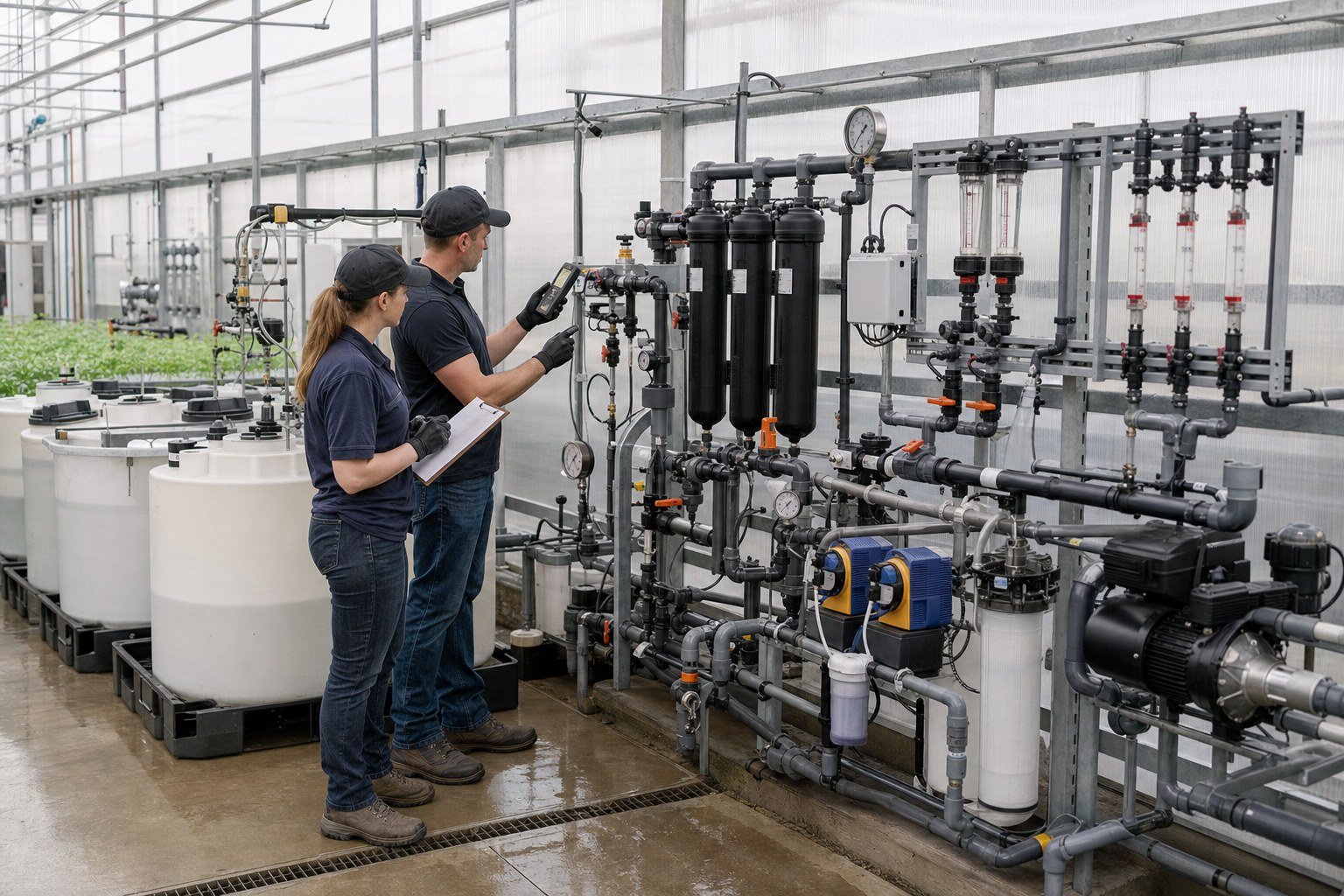
Issue the RFQ with accredited source-water and return-water analyses, crop and substrate, recipe ranges, irrigation flow and pressure by zone, maximum simultaneous demand, daily volume, source and treated-water storage, fertilizer and acid products, stock concentrations, number of channels, injection range and accuracy, EC and pH targets, filtration, disinfection, backflow protection, drain and containment, controls, alarms, data, cleaning, calibration, spares, training, and acceptance tests.
The same nominal dosing unit can perform very differently when the project has low-flow nursery zones, high-flow crop blocks, variable source pressure, concentrated acids, recycled drain water, or several recipes running in sequence. Minimum stable dose and response at the smallest zone can matter as much as maximum capacity.
Water pH alone does not describe acid demand. Alkalinity, hardness, nutrients, salts, suspended solids, microbes, and source variation affect treatment, compatibility, filtration, and recipe control. Samples should represent the actual sources and seasons that will feed the system.
This planning guide supports procurement and coordination. Project-specific values and safety decisions remain with the grower, qualified designers, equipment manufacturers, contractors, and authorities responsible for the installation.
Inputs that should be fixed before supplier selection
| Input group | Record | Decision supported |
|---|---|---|
| Water and chemicals | Source analyses, seasonal variation, return-water analysis, fertilizer products, acid or alkali, disinfectants, stock concentration, compatibility, safety data, and local restrictions. | Defines treatment, materials, dosing, storage, and risk controls. |
| Hydraulic duty | Flow and pressure for each zone, minimum and maximum operating flow, simultaneous zones, daily and peak volume, flush and backwash demand, source pressure, tanks, pumps, and future phase. | Sets equipment range and pump duty. |
| Dosing and measurement | Number of channels, recipe range, injection accuracy, mixing method, EC and pH range, sensor accuracy, sampling point, calibration method, response time, bypass, and manual mode. | Defines how nutrient targets are produced and verified. |
| Protection and sanitation | Filtration, disinfection, backflow prevention, check valves, chemical containment, ventilation, eyewash, drainage, cross-connection control, clean-in-place, flush, and waste handling. | Protects source water, workers, crops, and equipment. |
| Controls and handover | Zone interface, recipe permissions, alarms, trends, remote access, cybersecurity boundary, power failure response, reports, manuals, drawings, certificates, spares, training, and field tests. | Makes operation traceable and maintainable. |
Identify each provisional item and the date by which it must be closed. A supplier can offer alternatives, but each alternative should state which input changed and how that change affects capacity, layout, utilities, controls, maintenance, and price.
A practical design and review sequence
1. Build the demand envelope by zone
For every irrigation zone, record emitters, count, design flow, pressure, irrigation duration, cycles, substrate, drainage target, and crop stage. Identify the smallest zone, largest zone, simultaneous combinations, flush cycles, filter backwash, and future expansion. The equipment must control accurately across this operating range.
2. Define recipes without locking procurement to one crop
Provide expected EC and pH ranges, nutrient families, stock concentrations, number of independent channels, recipe changes, source-water correction, and return-water blending. Ask the agronomist to define permitted ranges while the equipment supplier confirms metering turndown, material compatibility, mixing, and response.
3. Separate measurement, control, and verification
The in-line EC and pH instruments support automatic control, but acceptance should include calibrated independent measurements at defined sampling points. Specify buffers and standards, storage solution, cleaning, temperature compensation, calibration interval, probe replacement, and how an out-of-range or implausible signal changes operation.
4. Test normal and abnormal modes
Demonstrate the smallest and largest zones, recipe change, source change, low stock, empty tank, low flow, high pressure, failed probe, filter alarm, communication loss, power restoration, manual operation, flush, and emergency stop. Measure delivered flow, pressure, EC, pH, dose repeatability, carryover, and alarm routing.
Keep the assumptions with the calculation or equipment schedule. When the crop plan, source condition, greenhouse geometry, or operating sequence changes, the responsible designer can then identify which result must be recalculated instead of relying on an obsolete approval.
Divide responsibilities at the interfaces
Owner and grower
Provide crop, operating hours, acceptable risk, local practices, staff capability, utilities, expansion plan, and approval priorities.
Greenhouse supplier
Provide structure, envelope, equipment, layout, loading, utility, control, installation, and commissioning interface data within the contracted scope.
Specialist designer
Apply local climate, codes, calculation methods, safety duties, equipment selection, system integration, and professional approval.
Contractor and operator
Confirm site conditions, installation, access, testing, records, training, safe operation, inspection, and maintenance.
Use a responsibility matrix for supply, design, installation, power, water, drainage, controls, network, civil works, testing, permits, consumables, spares, training, and warranty response. Phrases such as complete system are not enough when the interfaces cross several contracts.
Common specification failures
| Failure | Why it matters and what to do |
|---|---|
| Only maximum flow is specified | The dosing system may hunt or overfeed at small zones. Provide minimum stable operating flow and every credible zone combination. |
| Water pH substitutes for a complete test | Alkalinity and other constituents determine treatment demand and risk. Use a suitable laboratory analysis and describe seasonal sources. |
| Chemical names are left open | Materials and pump technology must suit actual fertilizers, acids, disinfectants, temperatures, and concentrations. Provide products and safety data before manufacture. |
| Acceptance checks only the screen display | Verify delivered solution with independent calibrated instruments and representative zone operation. Include sampling location, stabilization time, and allowable deviation. |
Record every accepted deviation. A verbal clarification during a meeting should be transferred to the controlled drawing, schedule, calculation, or specification that governs manufacture and site work.
Plan acceptance before equipment is ordered
Agree on document review, factory checks where appropriate, delivery inspection, installation inspection, pre-start checks, calibration, functional tests, representative operating tests, abnormal-mode tests, training, and handover. State the instruments, conditions, tolerances, data format, witnesses, and corrective-action process.
Use the project commissioning plan to connect design intent to field evidence. Where continuity matters, coordinate power, alarms, operator response, and recovery through the site resilience plan. Keep final settings, test results, and approved changes with the equipment record so maintenance staff have a usable baseline.
Acceptance is not a substitute for ongoing observation. Trend the measurements that reveal deterioration, compare them with the commissioned condition, and define who investigates a sustained change. This is particularly important where crop damage can begin before a component reaches complete failure.
Questions the project team should answer
Which water sources and seasons must be handled? What are the smallest and largest zone flows? Which recipes, stock concentrations, acids, and disinfectants are expected? Is return water blended, treated, or kept separate? What prevents backflow and cross-connection? Where do leaks and flush water go? Which users can change recipes? How are calibration, trends, alarms, spares, and chemical safety managed?
Frequently asked questions
How many fertilizer channels should be requested?
Base the number on incompatible concentrates, recipe flexibility, acid or alkali correction, future crops, and the agronomist plan. More channels add flexibility but also valves, calibration, cleaning, controls, and failure points.
Is EC enough to control fertilizer concentration?
EC indicates total ionic conductivity, not the concentration of each nutrient. Use it within a defined recipe and water-quality program, with pH, stock preparation, laboratory checks, and crop monitoring.
Should acid injection be part of the same skid?
It can be integrated, but the design must address chemical compatibility, injection order, mixing, containment, ventilation, backflow protection, operator safety, maintenance, and local rules. The specific arrangement requires qualified review.
What documents should suppliers return with a bid?
Request a compliance schedule, process description, hydraulic data, dosing range, materials list, layout, utility loads, I/O, control narrative, alarms, safety features, exclusions, consumables, calibration needs, spare parts, delivery scope, tests, training, and warranty.
Prepare the input schedule before requesting a fixed offer
Send water analyses, crop and substrate plan, zone schedule, daily and peak demand, pressure, fertilizer and acid products, recipe ranges, reuse strategy, utilities, safety rules, and control requirements. Chengfei Greenhouse can coordinate greenhouse irrigation interfaces for a complete fertigation RFQ.
Contact Chengfei GreenhouseReferences
- A Water Quality Toolkit for Greenhouse and Nursery Production. A Water Quality Toolkit for Greenhouse and Nursery Production.
- Drip Irrigation for Vegetable Production. Drip Irrigation for Vegetable Production.
- NRCS National Engineering Handbook, Chapter 7 Microirrigation. NRCS National Engineering Handbook, Chapter 7 Microirrigation.