
A supplier says that slowing a fan by 20% can almost halve its power demand. The arithmetic can be reasonable under the fan laws. The purchasing mistake is assuming that it means half the annual ventilation bill while the greenhouse receives the same cooling.
A variable-frequency drive, or VFD, changes the speed of a compatible motor. Its value depends on whether the greenhouse can use reduced airflow for enough operating hours, whether the fan and motor remain within their allowed range, and how the complete ventilation system responds.
Understand what the cubic rule leaves out
For a comparable fan operating under appropriate similarity conditions, airflow varies approximately with speed, pressure with speed squared and shaft power with speed cubed. At 80% speed, the simple power ratio is 0.8 cubed, or 0.512. The corresponding airflow is also lower; this is not free cooling.
The US Department of Energy's adjustable-speed drive guidance explains these part-load relationships and the role of motor and drive efficiency. Use the equations for a preliminary comparison, then use equipment curves and measured duty points for the actual proposal.
Decide which fan you are controlling
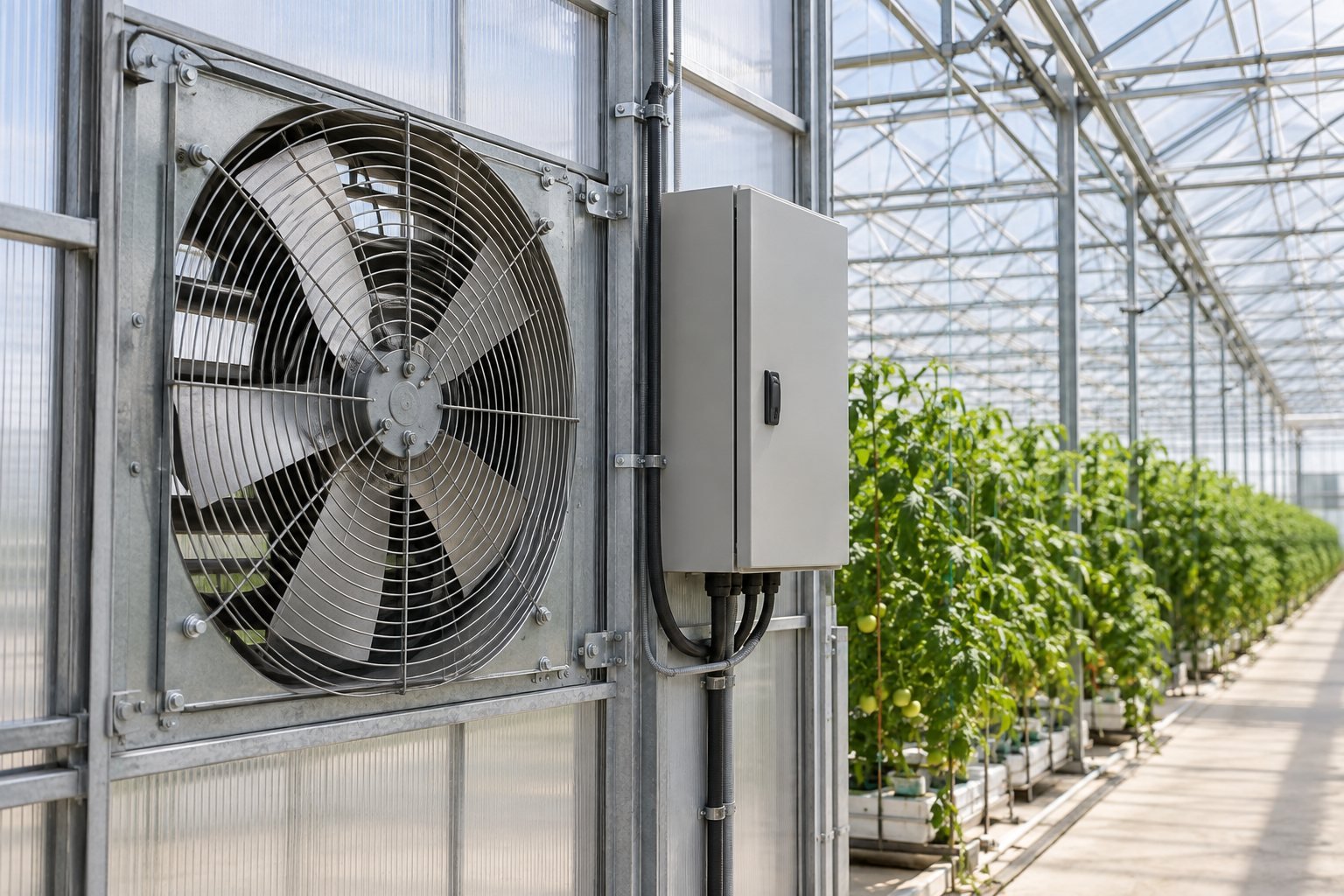
An exhaust fan removes air through the greenhouse envelope. A circulation fan redistributes air inside. Reducing either can affect the crop, but they perform different jobs. Do not copy an exhaust-fan control rule onto an internal circulation system simply because both motors can be slowed.
| Retrofit question | Evidence needed | Reason to reject a shortcut |
|---|---|---|
| Is the motor suitable? | Motor and drive manufacturer's written compatibility and operating limits | Not every existing motor or electronic fan accepts an external VFD |
| What is the real airflow? | Fan curve at the installed pressure, including pads, screens and shutters | A free-air rating omits system resistance |
| How low can speed go? | Motor cooling, shutter operation and crop-level ventilation requirements | Electrical operation alone does not prove useful airflow |
| What happens on a fault? | Alarm, fallback and emergency ventilation sequence | A quiet failed fan may look like normal low-speed operation |
Build an operating-hours comparison
List the hours spent at each current ventilation stage and the conditions during those hours. Estimate the proposed stages only where they can meet the required duty. Include drive losses, control power and other equipment affected by the change. Cooling-pad pumps or backup fans may not follow the same power curve.
For a transparent example, suppose a measured fan input is 2 kW for 1,000 comparable operating hours. The baseline for that interval is 2,000 kWh. If the proposed system is measured at 1.2 kW while meeting the required airflow for those same hours, the difference is 800 kWh. The example assumes matched duty; it is not a CFGET saving estimate or an annual prediction.
Check the crop while commissioning
Have a qualified electrical installer commission the drive and its protections. At each approved operating stage, record power, pressure or airflow evidence and greenhouse temperature patterns. Check far-end and sheltered crop positions, not only the controller location.
Verify that shutters open as intended and that transitions do not create hunting between stages. Test the approved failure response with the installer. Do not improvise motor wiring or defeat overload protection to make an incompatible fan run.
Use the retrofit only where the duty supports it
A greenhouse that needs full ventilation through nearly all demanding hours may have limited part-load savings. A house with long moderate-load periods may offer a better opportunity, but only after minimum airflow and humidity-management needs are considered.
Prepare the fan nameplates, installed resistance details and operating log before discussing the change with CFGET. The fan-and-pad design input guide helps define that system boundary. Ask for an operating map and verification method, not just a percentage attached to the cubic equation.