
The short answer
Provide hourly summer dry-bulb and wet-bulb data, target crop conditions, acceptable temperature gradient, greenhouse geometry and heat gains, crop resistance, pad-to-fan path, envelope leakage, required airflow at system static pressure, fan performance data, pad type and face-velocity limits, water analysis, distribution and bleed strategy, pump and sump data, drainage, controls, power, access, and acceptance measurements.
Evaporative cooling approaches the outdoor wet-bulb temperature, not an arbitrary setpoint. Its potential is strong when the wet-bulb depression is large and limited when outdoor air is already humid. The RFQ should therefore identify coincident dry-bulb and wet-bulb conditions rather than a single maximum temperature.
Air warms as it crosses the greenhouse and collects heat from the roof, crop, floor, equipment, and solar radiation. Long travel, high crop density, blocked aisles, open doors, leaking cladding, dirty pads, and fans operating away from their rated point can produce uneven conditions even when the equipment nameplates look adequate.
This planning guide supports procurement and coordination. Project-specific values and safety decisions remain with the grower, qualified designers, equipment manufacturers, contractors, and authorities responsible for the installation.
Inputs that should be fixed before supplier selection
| Input group | Record | Decision supported |
|---|---|---|
| Climate and target | Hourly dry-bulb, wet-bulb or humidity, solar radiation, elevation, wind, target crop temperature and humidity, operating season, and allowable gradient. | Defines theoretical cooling potential and the required operating case. |
| Air path | Greenhouse volume, pad-to-fan distance, crop layout, screens, partitions, doors, vents, leakage, obstructions, inlet and discharge clearances, and recirculation risk. | Defines resistance and uniformity. |
| Fans | Certified airflow at stated static pressure, quantity, staging, efficiency, motor and drive, shutters, guards, spacing, service access, discharge, and backup strategy. | Prevents free-air ratings from being used as installed duty. |
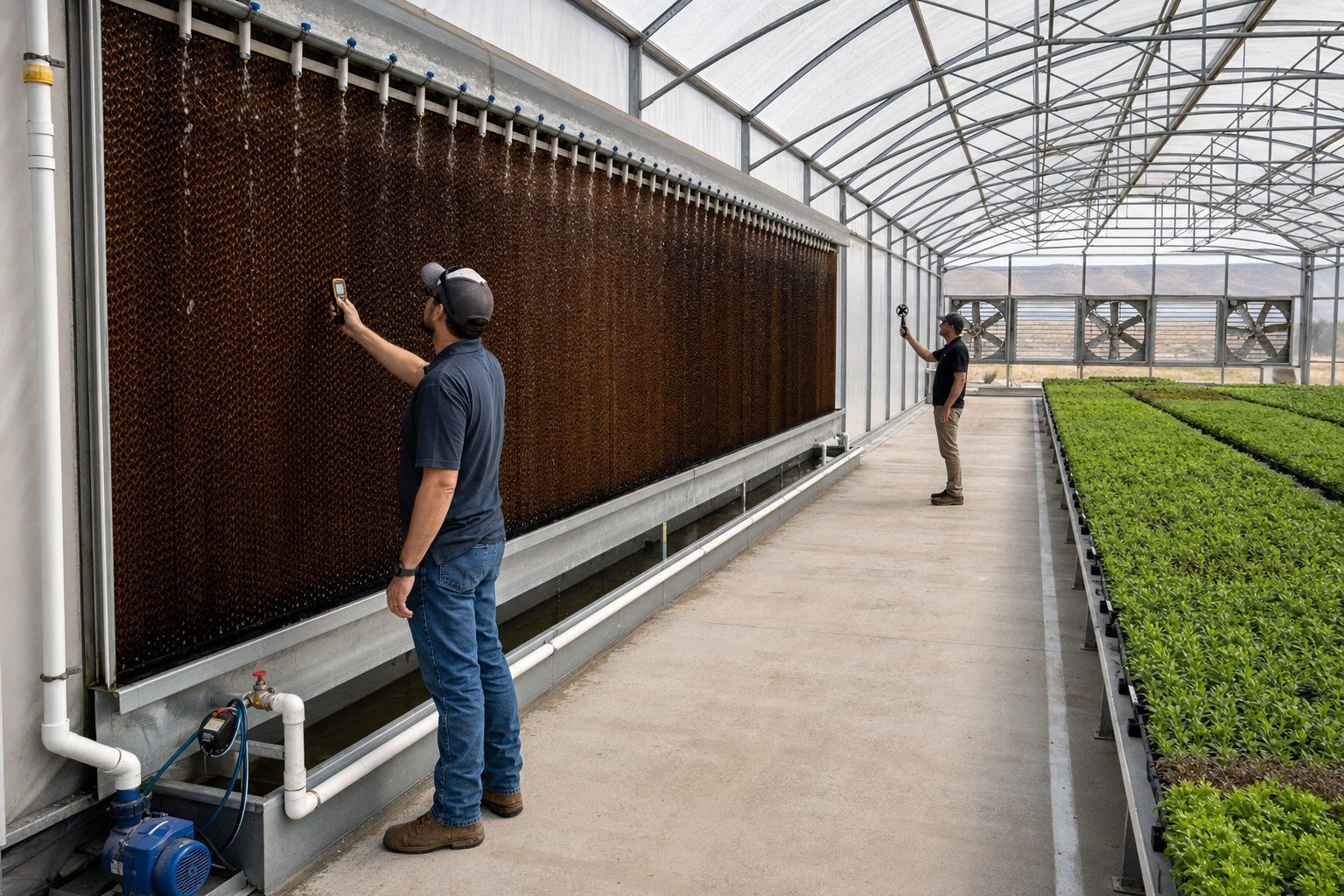
| Pads and water | Pad material, thickness, area, face velocity, distribution header, pump, sump, flow, make-up, bleed, filtration, water analysis, overflow, drainage, winter closure, and cleaning. | Controls wetting, mineral buildup, biological growth, and water use. |
| Controls and proof | Sensors, stages, vent and door interlocks, pump lead time, low-water protection, alarms, power restoration, airflow, pressure, wetting, temperature traverse, and record format. | Turns equipment into a verifiable system. |
Identify each provisional item and the date by which it must be closed. A supplier can offer alternatives, but each alternative should state which input changed and how that change affects capacity, layout, utilities, controls, maintenance, and price.
A practical design and review sequence
1. Check psychrometric feasibility first
Calculate expected entering-air temperature from coincident outdoor dry-bulb, wet-bulb depression, and realistic pad efficiency. Then add the expected temperature rise across the greenhouse. If the crop target cannot be met during humid design hours, the project needs a different setpoint, added shading, reduced heat load, another cooling method, or a revised production strategy.
2. Develop the full resistance path
Start outside the pad and follow air through weather screens, pad material, crop, benches, screens, internal partitions, fan guards, shutters, and discharge. Select fans from certified performance at the calculated system static pressure. Confirm inlet air is not short-circuited from the hot fan discharge or an adjacent greenhouse.
3. Design uniform water distribution
The pad should wet evenly without dry streaks, excessive carryover, or stagnant zones. Coordinate header holes, pressure, recirculation flow, sump working volume, pump submergence, make-up, overflow, bleed or treatment, filtration, access, and safe cleaning. Water analysis should guide scale and biological-control planning.
4. Test the system under representative load
Record outdoor and entering-air dry-bulb and wet-bulb conditions, pad pressure drop, fan stages, static pressure, airflow indicators, water flow, sump level, and a temperature traverse from pad to fan. Inspect shutters, vibration, noise, leaks, dry pad areas, bypass gaps, and recirculation. A single thermometer near the pad cannot prove whole-house performance.
Keep the assumptions with the calculation or equipment schedule. When the crop plan, source condition, greenhouse geometry, or operating sequence changes, the responsible designer can then identify which result must be recalculated instead of relying on an obsolete approval.
Divide responsibilities at the interfaces
Owner and grower
Provide crop, operating hours, acceptable risk, local practices, staff capability, utilities, expansion plan, and approval priorities.
Greenhouse supplier
Provide structure, envelope, equipment, layout, loading, utility, control, installation, and commissioning interface data within the contracted scope.
Specialist designer
Apply local climate, codes, calculation methods, safety duties, equipment selection, system integration, and professional approval.
Contractor and operator
Confirm site conditions, installation, access, testing, records, training, safe operation, inspection, and maintenance.
Use a responsibility matrix for supply, design, installation, power, water, drainage, controls, network, civil works, testing, permits, consumables, spares, training, and warranty response. Phrases such as complete system are not enough when the interfaces cross several contracts.
Common specification failures
| Failure | Why it matters and what to do |
|---|---|
| Dry-bulb temperature is the only climate input | Without coincident wet-bulb or humidity, the achievable evaporative temperature cannot be assessed. Use hourly paired conditions. |
| Fans are selected at free-air capacity | Pads, crops, shutters, screens, and openings add resistance. Select certified airflow at the calculated installed pressure. |
| Openings bypass the pad | Uncontrolled doors, vents, holes, and loose cladding admit warm air without cooling and disturb distribution. Define the sealed mechanical-cooling mode and safe exits. |
| Water quality is postponed | Mineral scale, sediment, algae, and biofilm reduce wetting and airflow. Test the source and include filtration, treatment, bleed, cleaning, and disposal from the start. |
Record every accepted deviation. A verbal clarification during a meeting should be transferred to the controlled drawing, schedule, calculation, or specification that governs manufacture and site work.
Plan acceptance before equipment is ordered
Agree on document review, factory checks where appropriate, delivery inspection, installation inspection, pre-start checks, calibration, functional tests, representative operating tests, abnormal-mode tests, training, and handover. State the instruments, conditions, tolerances, data format, witnesses, and corrective-action process.
Use the project commissioning plan to connect design intent to field evidence. Where continuity matters, coordinate power, alarms, operator response, and recovery through the site resilience plan. Keep final settings, test results, and approved changes with the equipment record so maintenance staff have a usable baseline.
Acceptance is not a substitute for ongoing observation. Trend the measurements that reveal deterioration, compare them with the commissioned condition, and define who investigates a sustained change. This is particularly important where crop damage can begin before a component reaches complete failure.
Questions the project team should answer
What are the coincident outdoor dry-bulb and wet-bulb design conditions? What entering and far-end crop temperatures are acceptable? What is the complete air resistance at maximum crop density? Are fan data certified at that pressure? How is bypass leakage controlled? What water quality and discharge limits apply? How will pads be drained or isolated in winter? Which measurements demonstrate uniform cooling after installation?
Frequently asked questions
Can fan-and-pad cooling maintain the same temperature in every climate?
No. The minimum practical entering-air temperature depends on outdoor wet-bulb conditions and pad efficiency. Air then warms across the greenhouse. Humid climates offer less evaporative potential than hot, dry climates.
How far can air travel from pad to fan?
Shorter travel generally limits temperature rise and improves uniformity. The acceptable distance depends on crop tolerance, house geometry, heat gain, airflow, and obstructions. UF/IFAS guidance notes practical limits, but the project must be checked as a complete system.
Should roof vents stay open when exhaust fans operate?
The intended mechanical-cooling mode normally controls other openings so air enters through the pads. The exact sequence, emergency egress, wind response, and transition to natural ventilation must be designed and tested.
What data should be recorded at commissioning?
Record outdoor and indoor dry-bulb and wet-bulb conditions, fan stages, static pressure, water flow, pad wetting, sump behavior, temperature along the air path, motor readings, alarms, interlocks, and observed bypass or recirculation.
Prepare the input schedule before requesting a fixed offer
Send hourly summer climate data, crop and target conditions, greenhouse layout, section, crop density, screens, pad and fan locations, water analysis, electrical supply, control modes, and access constraints. Chengfei Greenhouse can coordinate greenhouse geometry and equipment interfaces for the cooling-system design.
Contact Chengfei GreenhouseReferences
- Fan and Pad Greenhouse Evaporative Cooling Systems. Fan and Pad Greenhouse Evaporative Cooling Systems.
- Florida Greenhouse Design. Florida Greenhouse Design.
- Psychrometric Chart Use. Psychrometric Chart Use.