
Compare greenhouse fan noise only after identifying the acoustic quantity and the airflow duty. Sound power describes emission from the source. Sound pressure describes the sound at a receiver under particular conditions. A lower catalog number is not automatically the quieter choice when one offer reports power and another reports pressure.
Start by asking where each number belongs: at the fan as an emission rating, or at a stated observation position. That distinction prevents an attractive but unsupported ranking before the greenhouse layout is even considered.
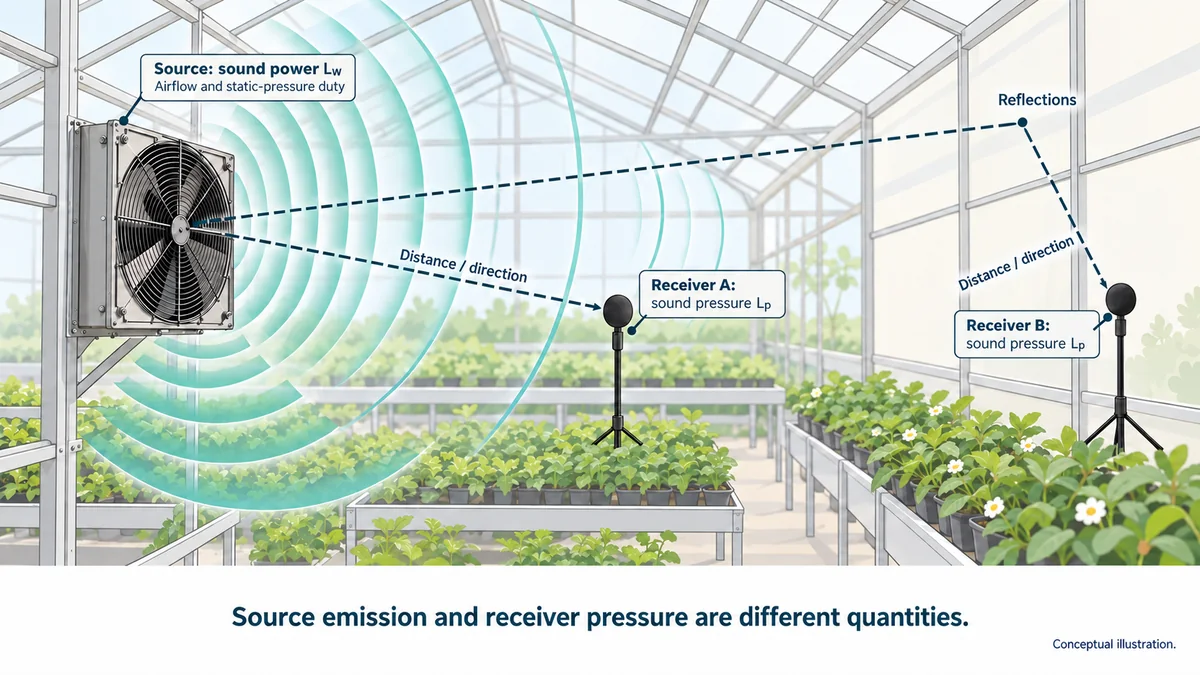
Follow the sound from source to receiver
At the source, fan design and aerodynamic duty affect sound emission. Along the path, distance, direction and surrounding surfaces matter. At the receiver, reflections and other operating equipment contribute to the measured sound. Moving the receiver changes its relationship to the source even when the fan's operating point stays the same.
Greenheck's September 2026 explanation links sound ratings to fan duty and distinguishes source power from receiver pressure. For greenhouse selection, that means keeping airflow and static pressure beside the sound data. Comparing one fan at a different duty can answer the wrong purchasing question.
UF/IFAS guidance on greenhouse fans includes noise among selection considerations. Use it alongside the required aerodynamic performance. A larger blade or a lower listed speed is not enough evidence to rank two complete offers.
Keep the quantity attached to the decibels
Look for Lw, sound-power level, or Lp, sound-pressure level, and the manufacturer's definition. A-weighting describes frequency weighting; an “A” beside dB does not, by itself, resolve which quantity was reported. Octave-band results also retain information that a single combined number cannot show.
Greenheck's August 2023 fan-sound guide explains the different reference quantities, installation categories and logarithmic calculations. Its special-case conversion assumptions should not be treated as a universal correction for a greenhouse.
| Offer detail | What to preserve | What prevents comparison |
|---|---|---|
| Source sound power | Quantity, band or weighting, inlet/outlet basis, installation type and fan duty | Different duty or an undefined source basis |
| Receiver sound pressure | Quantity, distance, direction, surroundings, background and measurement conditions | A different receiver position or missing conditions |
| Single weighted number | The underlying quantity and weighting definition | Only “quiet” or an unexplained dB value |
For example, suppose a purchasing sheet copies a source-power rating from offer A and a pressure value at an unspecified distance from offer B. Mark the pair “not comparable as supplied.” Do not subtract them and report the difference as a product improvement. Ask each supplier for the same quantity at the agreed fan duty. If the decision concerns sound at a work position or boundary, have that receiver question assessed separately.
Why two 60 dB contributions do not make 120 dB
Consider a fictional example with two independent sound contributions, each 60 dB at the same receiver on the same defined basis. Assume comparable frequency bands or weighting and representative stable conditions. Their energetic sum is:
10 log10(106 + 106) = 63.0103 dB, approximately 63 dB.
The logarithmic scale explains the result. It is neither ordinary addition nor an average. This exercise does not predict two installed fans: their contributions at the receiver still have to be established, and independence cannot simply be assumed for every sound situation. The answer also says nothing about acceptable exposure or site compliance.
Download the two-offer sound comparison
Download the fan-sound comparison CSV. It is a manual worksheet with no formulas or site-noise prediction. Import as UTF-8 with comma separators, widen and wrap the columns, then save an editable spreadsheet copy.
Enter each offer in its own column. First match the duty using the fan-and-pad design inputs where that system applies. Then identify the acoustic quantity and its conditions. Use the final rows to state either a supported like-for-like comparison or the exact missing information. Keep occupational exposure and boundary-noise acceptance with the appropriate qualified assessment rather than assigning a green pass to a catalog number.