
An expansion vessel in a closed greenhouse heating circuit accommodates fluid expansion. Its nominal litres are not the same as the litres of fluid in the system or the additional fluid volume created during warming. Keep those three quantities separate before interpreting a quotation.
This article concerns a membrane-type vessel in a closed, non-potable hot-water heating circuit. It explains the volume question a grower should take to the heating designer. It does not select a pressure vessel or supply settings for one.
Follow the fluid and gas inside the same shell
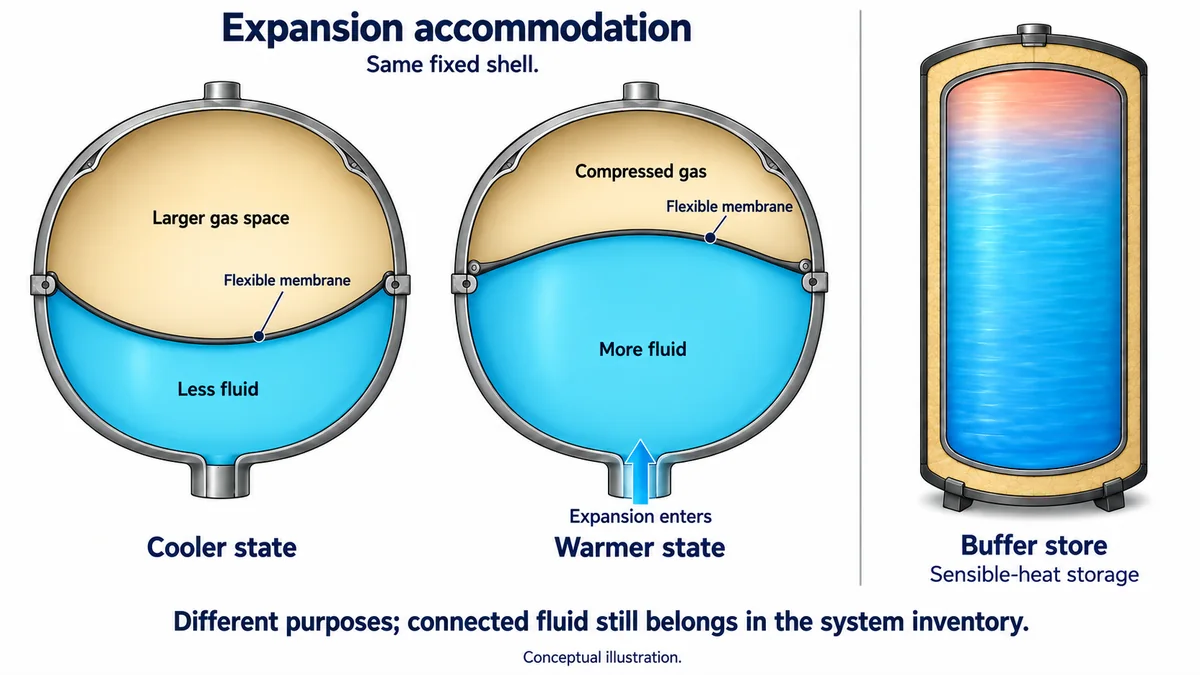
Imagine the same fixed outer shell in a cooler and a warmer state. A flexible membrane separates the fluid from a compressible gas compartment. As warming fluid enters the vessel, the membrane moves and the gas occupies less space. The shell has not become larger.
Caleffi's 01079/13 GB document illustrates this membrane-and-gas principle and distinguishes vessel volume, system water content and the volume increase from heating. The mechanism explains why the vessel's entire nominal capacity is not an empty receiving space available for expansion.
The working amount it can accept depends on its design and the qualified system pressure and temperature design. A catalog's maximum-acceptance figure also needs its definition and conditions. It is not automatically the working accommodation available in your proposed circuit.
Trace the three volumes on the proposal
| Volume | What it describes | Question to resolve |
|---|---|---|
| Connected system fluid volume | The fluid inventory inside the defined circuit | Which pipes, equipment and stores belong to that boundary? |
| Fluid expansion volume | The increase over the stated temperature interval for the specified fluid | Which properties and temperature conditions support the calculation? |
| Nominal vessel volume | The size of the separately selected expansion vessel | What working acceptance does that selection provide under the design conditions? |
For a document review, label each quoted litre figure with one of these meanings. If a line simply reads “expansion: 25 litres,” ask whether it means calculated fluid increase, nominal vessel capacity or a stated acceptance amount. Do not resolve the ambiguity by choosing whichever interpretation makes the proposed equipment look adequate.
The greenhouse application is real: Farm Energy's greenhouse root-zone heating guidance includes expansion equipment among closed-loop components. That context does not make an irrigation accumulator or an arbitrary storage tank an equivalent substitute.
A buffer addition changes the fluid inventory
Consider explicitly fictional arithmetic. A documented circuit contains 2,000 L. A proposed connected buffer adds 500 L to that same closed circuit. Assume the same fluid and the same stated temperature interval throughout, and assume solely for this illustration that the fluid volume increases by 1% across that interval.
- Before the addition: 2,000 × 0.01 = 20 L of calculated increase.
- After the addition: 2,500 × 0.01 = 25 L of calculated increase.
- The increase is 5 L, or 25% above the earlier 20 L.
The 1% is an invented example assumption, not a fluid coefficient to use in a project. Neither 20 L nor 25 L is the required nominal vessel size. No pressures, reserve allowance or product have been selected, so the vessel-selection result is deliberately left uncomputed.
The purchasing consequence is specific: send the revised connected-fluid inventory to the heating designer for review of expansion accommodation. If a heat exchanger separates an additional fluid circuit so that its fluid does not mix with the original circuit, establish that separate boundary. Ordinary hydraulic separation within shared fluid does not remove that fluid from the inventory.
Keep heat storage and pressure protection separate
A buffer store adds thermal mass and can store sensible heat. Caleffi's hydronic-system discussion distinguishes thermal-mass considerations from closed-system pressure protection. The separate greenhouse buffer-tank article addresses usable heat and discharge time.
A connected buffer can therefore serve a heat-storage purpose while also adding fluid that expands. Its storage capacity does not replace the expansion vessel's function. Pressure-relief protection is another separate safeguard; it is not a substitute for providing expansion accommodation.
Download the three-volume trace
Download the three-volume trace CSV. This manual worksheet has no formulas or vessel-sizing calculation. Import as UTF-8 with comma separators, widen the columns and wrap text, then save an editable spreadsheet copy.
Use the blank proposal column to identify the circuit boundary, fluid inventory, stated expansion calculation and separately selected vessel. Keep the fictional before-and-after example in its own columns. Finish by recording the ambiguous litre figure or missing design basis to resolve. The worksheet needs document evidence, not draining, charging, tapping or operating a live pressured system.