
The short answer
Choose one or two capabilities to prove, such as night alarm escalation, safe evacuation and head count, generator deployment, water-interruption response, manual operation during network loss or crop hold after a treatment fault. Write a safe exercise brief with scope, controllers, stop word, simulated inputs, no-confusion controls, observers and success evidence. Let participants use the real plan and records rather than a special drill script. Immediately afterward, run a short hot wash: ask what happened, what helped, what blocked the response and which risk appeared. Then issue an after-action record that separates observations from causes, assigns each correction to one owner and due date, and names the retest needed. A revised document does not close a failed capability until the site demonstrates it.
Different exercises answer different questions. A walkthrough teaches locations and roles. A tabletop exposes authority and information gaps. A functional exercise tests calls, setup, decisions and records under simulated pressure. A full-scale exercise can involve outside services and needs much more coordination. Start with the least disruptive format that can produce valid evidence, then increase realism as the plan and team mature.
Greenhouse exercises should reflect seasons, shift coverage and coupled systems. A winter power scenario can include blocked access or an unavailable technician, but avoid adding complications simply to make the story dramatic. Each complication should test a defined capability. Protect crops and normal alarms, clearly separate simulation messages, and retain an exercise controller who can stop the drill when a real event occurs.
This guide is an operating-control framework. The approved design, crop plan, product labels, manufacturer instructions, site safety procedures, local law and directions from competent local professionals govern the actual work.
What the buyer should control
| Control point | Required record or action | Release evidence |
|---|---|---|
| Objective | State the decision, action or communication capability to prove and the evidence that will count. | Approved measurable exercise objective. |
| Scenario and scope | Define site, season, shift, crop condition, simulated failure, participating roles and excluded operations. | Exercise brief reviewed for realism and safety. |
| Controls | Set controller, stop word, real-emergency override, alarm markings, observer rules, crop protection and outside-party coordination. | Signed safety and no-confusion plan. |
| Participant performance | Observe detection, verification, authority, calls, safe actions, records, handover and recovery decisions without coaching. | Time-stamped objective observation log. |
| Hot wash | Gather immediate facts from participants, including successful aids, uncertainty, workarounds and hazards noticed. | Facilitated notes that distinguish observation from opinion. |
| Corrective action | Identify underlying cause, risk, interim control, owner, due date, resources and sites with the same exposure. | Approved action register with management accountability. |
| Retest and closure | Specify which failed step must be repeated, under what conditions, and what evidence proves the correction works. | Completed retest and updated controlled plan. |
Every open item needs an owner, due date, status and effect on safety, production, cost and recovery time. A note that something was discussed or is being handled does not prove closure.
A practical workflow
1. Select the capability from actual risk
Use incident history, seasonal hazards, untested changes, staff turnover and open audit findings. Write one plain objective. For example, prove that the night operator can identify a failed heating zone, reach an authorized decision maker and start the approved response using offline records.
2. Build a safe, credible scenario
Describe initial conditions and timed inputs. Decide what is simulated and what participants may operate. Review potential effects on people, crops, alarms, utilities, traffic and emergency services. Prepare a way to end simulation immediately.
3. Brief controllers and observers
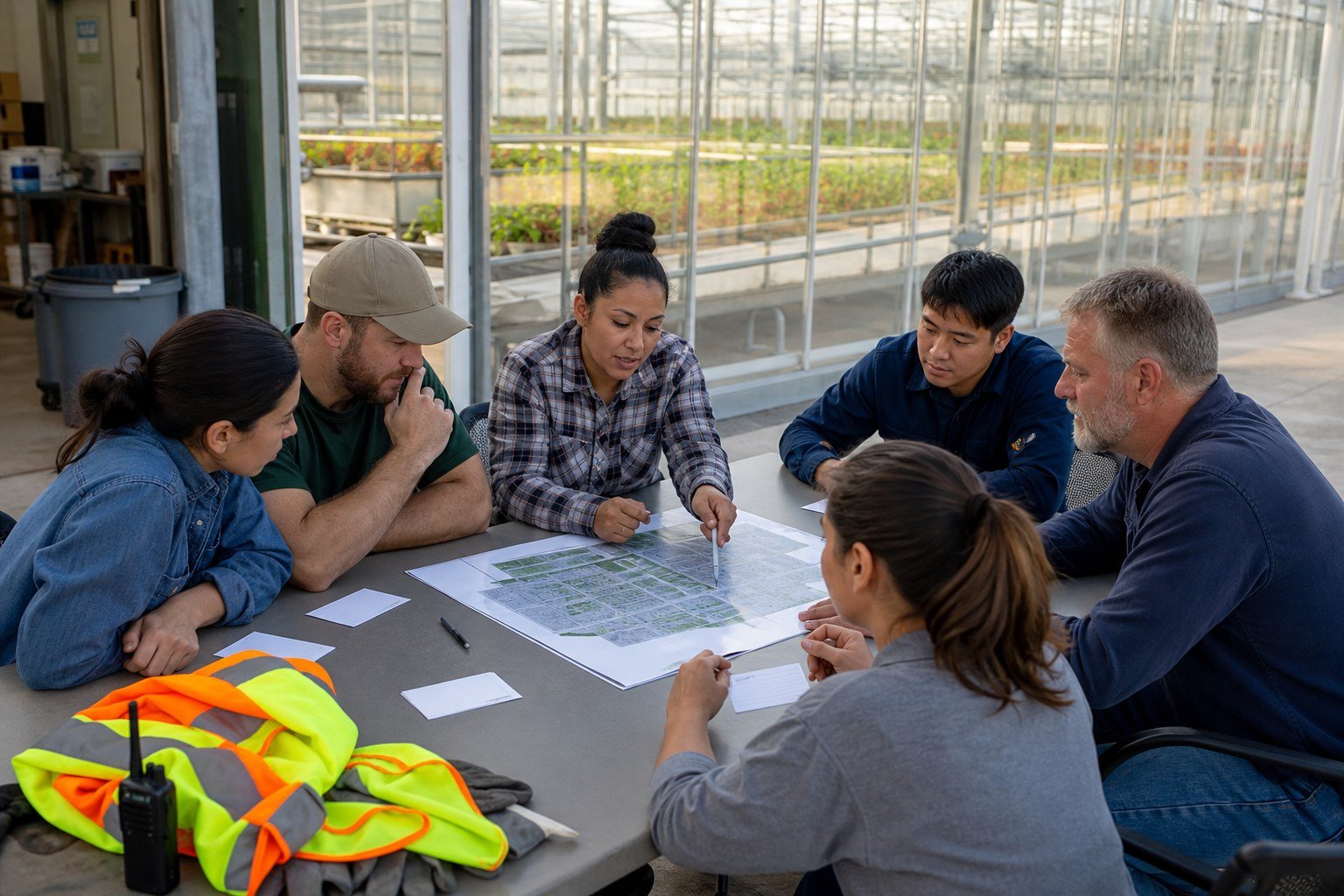
Controllers know the full sequence and keep the exercise safe. Observers receive objective check points and record times, words, actions and evidence. They should not rescue participants from a weak plan unless safety or the exercise boundary requires it.
4. Let the real system show its gaps
Participants use normal rosters, maps, phones, radios, procedures, spares and authority. Introduce only planned scenario information. If a real event occurs, stop the drill and return control to normal emergency procedures.
5. Run the hot wash while details are fresh
Ask participants to reconstruct the sequence and name what they expected to happen. Capture successful controls as well as gaps. Avoid blame and avoid deciding root causes before logs, records and observer notes are compared.
6. Write actions that change the system
For each important observation, ask why the plan, equipment, training, staffing or information allowed it. Choose a correction, interim control, owner, due date and resource. Check whether another greenhouse or shift has the same condition.
7. Retest the important failure
Repeat the failed communication, setup, decision or release step after correction. Use comparable conditions and record evidence. Update plans and training only after the working method is clear, then preserve both the finding and closure record.
Preserve the event sequence and earlier versions of records. The team should be able to reconstruct what was observed, which condition applied, who decided, what changed, how the result was tested and which limitation remained.
Who owns each decision
Exercise sponsor
Chooses risk and resources, accepts the scope, removes organizational barriers and holds owners accountable for closure.
Exercise controller
Protects people and operations, manages scenario inputs, prevents confusion with a real event and stops the exercise when needed.
Participants
Respond through normal roles and records, state decisions, report uncertainty and contribute factual observations during review.
Observers and action owners
Observers capture objective evidence. Action owners correct assigned gaps and arrange the required retest.
Release evidence before the next step
Close an exercise finding only after the corrective owner has completed the change, affected plans and people are updated, and the specified retest demonstrates the capability. If a permanent correction needs time, record an interim control and keep the finding open. Management acceptance of a report is not the same as operational closure.
Common failure modes
| Failure | Buyer response |
|---|---|
| The objective is to test the whole plan | Choose a small number of measurable capabilities so observers can collect useful evidence. |
| Participants receive a special drill script | Let them use normal plans and resources, with only the scenario information they would reasonably receive. |
| The scenario disables a live safeguard | Use controlled simulation and no-confusion measures. Do not create the hazard being tested. |
| The hot wash becomes a blame session | Collect facts and system conditions first, then analyze causes with the right evidence and people. |
| Every finding says provide more training | Correct missing design, authority, access, maintenance or information controls when training cannot solve the cause. |
| Actions close when the procedure is edited | Retest the failed capability and retain evidence that the correction works. |
Buyer decision questions
Which untested capability could create the greatest loss? What is simulated and what may operate? How will everyone distinguish the drill from a real emergency? Who can stop it? What will observers record? Which participants and shifts are absent? What underlying condition caused each gap? Which correction needs a functional retest rather than a document check?
Keep these decisions connected to the business continuity plan, the emergency call tree test, the operator competency checklist. The emergency plan, equipment evidence and crop plan should describe the same operating reality.
Frequently asked questions
How realistic should the first drill be?
Start with a walkthrough or tabletop if roles and plans are new. Add functional actions after basic gaps are corrected. Realism should serve the objective, not create risk.
Should participants know a drill is planned?
They need enough information to work safely and avoid confusing others. The exercise controller can still preserve uncertainty about timing or scenario details within approved boundaries.
Can a real incident replace a drill?
A real event provides evidence, but the site should still review it systematically, correct gaps and test capabilities that the event did not cover.
Who should attend the after-action review?
Include the people who acted, observed, owned relevant systems and can authorize corrections. Invite external responders or contractors when their interface was tested.
What makes a finding closed?
A completed correction, updated records and a proportionate verification or retest showing that the failed capability now works.
Turn the requirement into a controlled deliverable
Share the site emergency plan, recent incidents, open findings, seasonal risk and staff coverage. Chengfei Greenhouse can support exercises involving supplied systems while the owner and local safety authorities control the drill and approve emergency procedures.
Contact Chengfei Greenhouse