
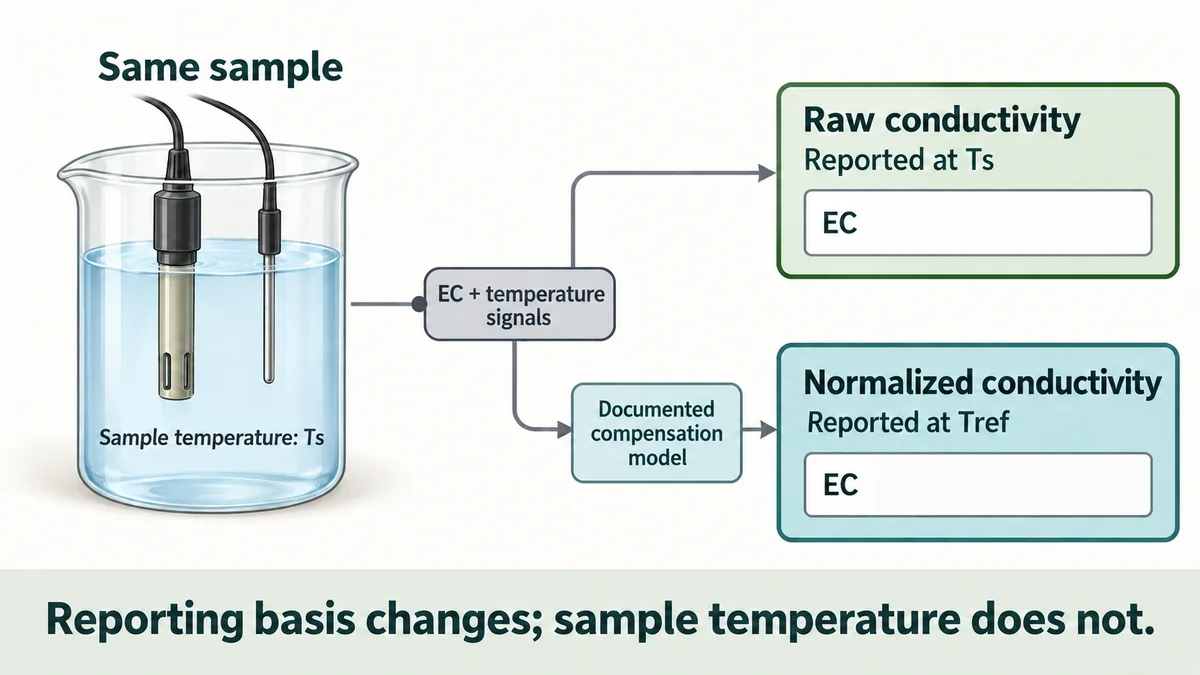
Two EC meters can disagree because they report the same solution on different temperature bases. Before changing greenhouse feed, establish whether each number is conductivity at the sample's actual temperature or conductivity normalized to a reference temperature. The letters ATC alone do not settle that question.
A real solution change remains possible. The first task is to make the readings comparable, then investigate any disagreement that remains. Changing fertilizer to reconcile unlike displays can create a nutrient change that the original numbers never demonstrated.
Separate sample temperature from the reported EC basis
Electrical conductivity depends on the movement of ions. Temperature changes that movement, so conductivity can change even when no fertilizer or water has been added. Hanna's temperature-compensation explanation separates uncompensated conductivity from a value corrected to a named reference temperature.
| Quantity | What it describes | What stays separate |
|---|---|---|
| Measured sample temperature | The temperature sensed in the actual sample | A reference-temperature label does not cool that liquid |
| Uncompensated conductivity | Conductivity at the measured sample temperature | It cannot be compared as though it were already normalized |
| Reference-temperature conductivity | A calculated value on the documented reference basis | Its meaning depends on the compensation model and sample |
Automatic temperature compensation applies a model or coefficient using measured temperature. Two instruments can both offer ATC while using different reference temperatures or coefficients. Record those details from the specific manuals or saved settings rather than assuming that matching labels mean matching calculations.
See what normalization changes
Consider a fictional linear model in which the solution's validated coefficient is assumed to be 1% per °C relative to 25°C. This coefficient is invented for arithmetic and is not a recommended fertigation setting.
An uncompensated reading of 2.10 mS/cm at 30°C would be normalized as follows:
Reference EC = 2.10 / [1 + 0.01 × (30 − 25)] = 2.00 mS/cm at 25°C.
The two displayed EC numbers can describe the same sample under this assumed model. The liquid remains at 30°C. The calculation has changed the reporting basis; it has neither removed ions nor established whether the crop should receive that solution.
Keep the percent notation straight: 1% enters that equation as 0.01 per °C, not 1. A meter may request its coefficient in percentage units instead. Use its documented convention; this article does not authorize changing a live controller to the example value.
Check whether the model belongs to the solution
A 2013 USGS-hosted research abstract describes chemistry-dependent temperature compensation in natural waters, especially acidic waters. Its findings support checking the model's applicability. They do not supply a correction coefficient for greenhouse feed, and the journal paper's full methods are not being used here.
Also allow the temperature measurement to stabilize according to the instrument procedure. Hanna's conductivity troubleshooting article identifies temperature-sensor stabilization as a measurement concern. ATC cannot repair sample contamination or turn an unsettled measurement into a valid comparison.
Cell-constant calibration answers another question about the instrument's measurement response. Substrate extraction changes the sample being measured. EC-to-TDS conversion changes the reported quantity. Keep each issue separate so a temperature-basis correction does not get mistaken for a complete investigation.
Reconcile the displays before revising the feed
- Use records for the same identified sample and preserve the original display, unit and sample temperature for each meter. Do not overwrite one reading with a calculated replacement.
- Attach each instrument's compensation on/off state, reference temperature, documented model or coefficient, and stabilization observation.
- Classify the pair. Matching documented bases support a like-for-like comparison. Different bases require an explained normalization. Missing settings or uncertain model applicability leave the discrepancy unresolved.
- If disagreement remains on a supported common basis, investigate the instruments and sampling process before treating it as evidence for a dosing change.
For the broader source-water evidence needed in system design, see water tests before greenhouse irrigation design.
Download the two-meter temperature-basis card. This is a manual comparison tool with no formulas or automatic pass result. Import the UTF-8 comma-separated file, widen columns and enable text wrapping, then save a working copy. Complete one column per meter for the same sample, retaining the original unit and value. Write the comparison conclusion and missing evidence below the measurement fields. The fictional arithmetic belongs to the article; the card supplies no default coefficient and does not change dosing controls.