
A conventional solid-desiccant rotor needs a route for the moisture released during regeneration. A dry process-air outlet shows one part of the operation. To establish net moisture removal from the greenhouse, follow the captured water through the rotor and out of the chosen greenhouse boundary.
This is a useful first comparison with a condensing dehumidifier. The two systems move water through different states and require different services. A headline removal capacity is difficult to evaluate while either water route ends in an unlabeled arrow.
Follow the water through adsorption and regeneration
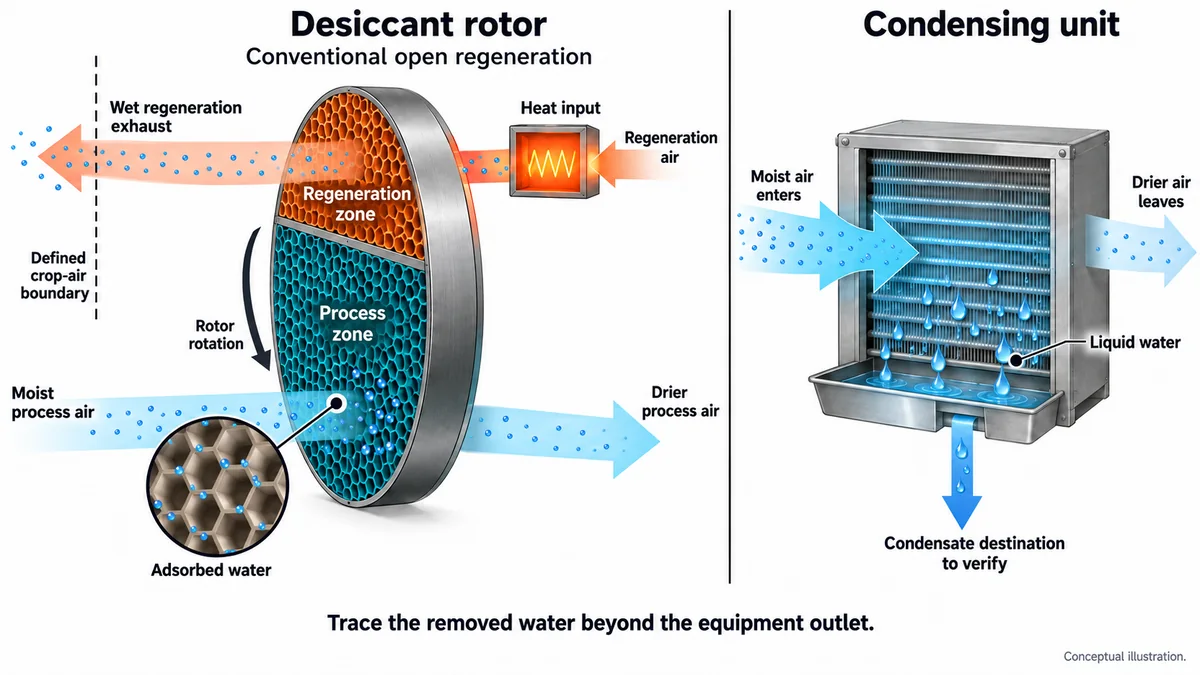
In a desiccant rotor, moist process air passes through a sorbent material. Water vapour is held on its surfaces by adsorption, and drier process air leaves. Rotation carries moisture-loaded material into a separate heated regeneration, or reactivation, stream. The material releases water into that stream, then rotates back for another process-air pass. Munters describes this repeating rotor cycle.
The wheel is therefore a reusable transfer medium, not a container that can store an unlimited crop's transpiration. In the conventional open-regeneration arrangement, the outgoing regeneration air carries the released moisture. Its destination belongs on the proposal drawing just as clearly as the dry-air destination.
Regeneration also requires a service input. For example, the Munters DEW product family lists electric, gas or steam reactivation options. That is evidence of separate service choices for that family, not a recommendation that a particular model suits a greenhouse or an instruction for connecting those services.
Compare the liquid-water route separately
A condensing unit cools process air sufficiently for some water vapour to become liquid. The collected condensate leaves through a drainage route; the refrigerant circulates in a different loop. In the greenhouse example described by the DryGair one-phase manual, Unit Overview, printed page 7, drier, warmer air returns to the greenhouse and condensed water is drained away.
| Route | Where crop-air moisture goes next | What must be traced beyond the unit |
|---|---|---|
| Conventional open-regeneration rotor | Onto the sorbent, then into regeneration air | Wet regeneration-air destination |
| Condensing unit | Into liquid condensate | Collected-water destination |
Warm outlet air alone cannot distinguish these routes or establish the building's water balance. Nor does collected condensate automatically become suitable irrigation or drinking water. Its final use needs its own quality and system review.
Draw the boundary before accepting the capacity
Consider two fictional offers. Offer A shows a rotor, a moist process inlet and a dry outlet returning to the crop, but gives no destination for regeneration exhaust. Offer B shows a cooling coil and a condensate outlet, but the drain line stops at the edge of the equipment sketch.
Neither drawing yet completes its water journey. For A, ask the supplier to identify the regeneration inlet, heat source, wet outlet and final destination. For B, ask where the liquid actually goes after collection. An equipment outlet is not necessarily the greenhouse boundary.
If A returns its wet regeneration air to the same crop space, the transferred water has come back. That route alone cannot establish net export. A hybrid or closed-regeneration design may include another removal stage, so ask to see that stage and its water destination rather than assuming every rotor system exhausts outdoors.
For B, a proposed storage or reuse connection should remain a named destination requiring review, not a promise that the water has permanently left every relevant balance. State whether the comparison concerns crop-space air, the whole greenhouse or the wider farm-water system.
Make the commercial comparison complete
Return each incomplete drawing with the missing route marked. Request capacity and service information for the actual entering-air conditions only after the mechanism is clear. Include regeneration energy in the rotor proposal and the relevant cooling and condensate arrangements in the condensing proposal. This identifies what the offers include without ranking their efficiency from the technology name.
For the wider project context, see commercial greenhouse design for hot and humid climates.
Download the water-journey comparison
Download the dehumidifier water-journey CSV. It is a manual comparison of the two mechanisms, with blank fields for actual destinations and service evidence. There are no formulas, sizing outputs or automatic approvals. Import as UTF-8, comma-separated text, widen and wrap the columns, then save a spreadsheet copy. Complete the chosen boundary and the final water destination before writing your comparison conclusion.