
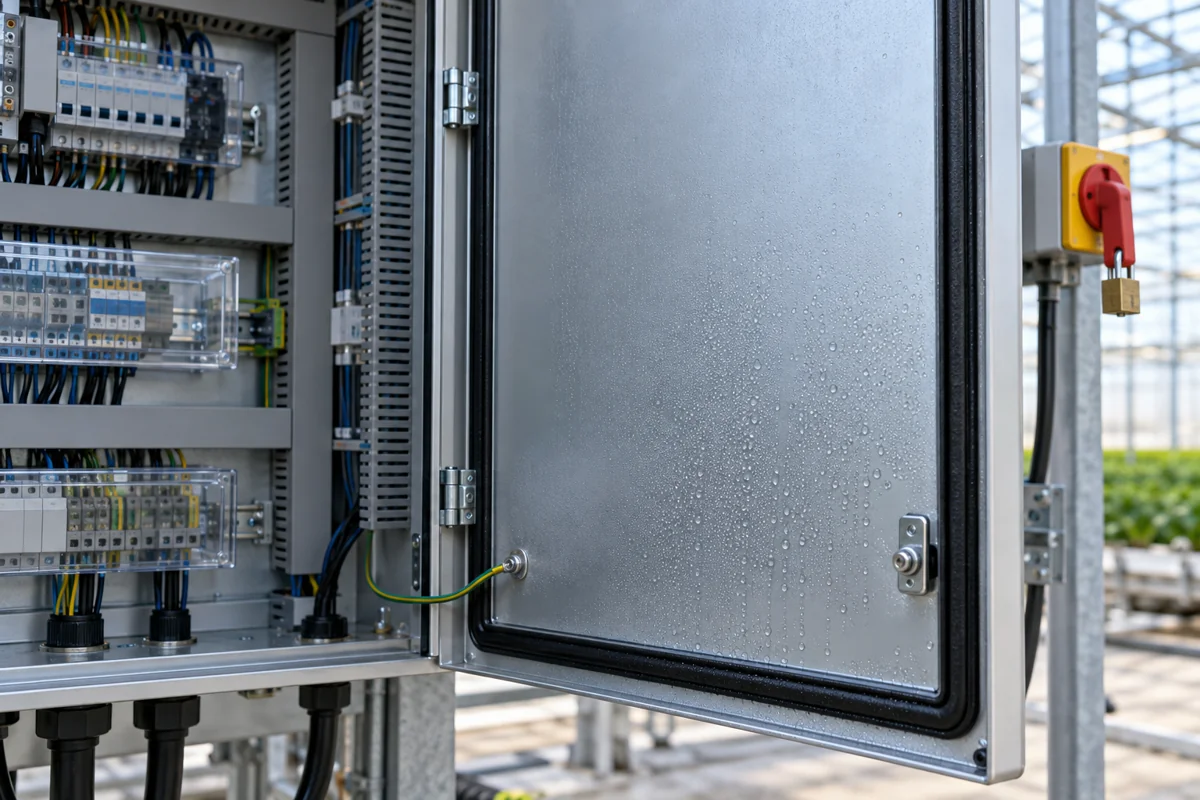
Moisture inside a greenhouse control cabinet does not automatically mean the enclosure needs a higher ingress-protection rating. Water may be entering through an unsuitable or damaged detail, forming as internal condensation, or arriving through more than one route. A useful investigation separates those possibilities before a replacement or accessory is specified.
The greenhouse owner's role is to collect safe observations and operating records. Opening the enclosure, assessing electrical damage and deciding whether it may be energized belong to qualified electrical and controls personnel.
Keep people safe before collecting evidence
If water is suspected inside electrical equipment, follow the site's electrical incident procedure and contact the responsible qualified person. Keep people away from exposed hazards. Do not open an energized enclosure, touch wet equipment, repeatedly reset a protective device or assume that a dry-looking exterior makes the contents safe.
Do not open a cabinet solely to take photographs for this checklist. Internal inspection, measurements and photographs must be obtained by authorized personnel after they have established the appropriate safe condition. Some equipment can contain stored energy or have more than one supply.
Use approved backup arrangements for affected irrigation, ventilation or other crop systems. A need to protect the crop does not justify bypassing electrical protection.
Understand what the rating answers
The IEC describes IP ratings as classifications of enclosure resistance to intrusion, including dust and liquids. A rating applies within its specified conditions. It is not a statement that the air inside will always remain dry or that every installed cable entry and accessory has been assembled correctly.
Condensation is a separate moisture mechanism. Water vapor can condense when it encounters a surface below the relevant dew point. Rittal's discussion of enclosure moisture explains how cool enclosure surfaces, humid internal air and changing conditions can contribute. Door openings, seals and cable-entry details also belong in the investigation.
That leaves two different questions for the supplier: does the installed assembly provide the required protection against the exposure outside it, and are its internal environmental conditions suitable? A higher rating alone does not answer both.
Build a timeline around the moisture event
Record when the problem was first noticed and when the equipment last operated normally. Add nearby irrigation, washing, rain exposure, maintenance and door-opening events. Include the time of any power interruption or change in equipment operation.
Keep observations separate from conclusions. “An error occurred before the morning irrigation cycle” is a useful timestamp. “Morning humidity caused the failure” needs more evidence. A photograph can show a location or visible condition, but it cannot by itself establish how moisture arrived.
Compare clocks before combining records from the greenhouse controller, cabinet monitoring and staff logs. Record the time zone and any known offset. An apparent sequence can reverse if two clocks are not aligned.
Send a non-intrusive evidence sheet
| Evidence | Record | Who verifies it |
|---|---|---|
| Cabinet model, identification and location | ________ | Owner record and controls supplier |
| Specified environment and protection rating | ________ | Designer or enclosure manufacturer |
| Date, time and visible external condition | ________ | Observer from a safe location |
| Weather, irrigation and wash exposure | ________ | Operating records |
| Door-opening and maintenance history | ________ | Authorized maintenance team |
| Existing internal and external sensor trends | ________ | Controls supplier checks suitability |
| Heater, cooling or ventilation status from existing records | ________ | Qualified service provider |
| Alarms, errors and power-state changes | ________ | Controller and electrical records |
| Seal and cable-entry condition | ________ | Qualified inspection where access is required |
| Internal moisture location and component condition | ________ | Qualified personnel under safe isolation procedure |
| Missing evidence and next action | ________ | Named responsible person |
Use existing approved sensors where available. A general greenhouse humidity sensor does not necessarily describe the cabinet interior. If internal measurements are missing, ask the supplier to design a suitable monitoring method. Do not place consumer sensors or temporary wiring inside electrical equipment yourself.
Ask the supplier to separate the possible routes
An external-ingress review should examine the enclosure specification, installation details, exposure and observed condition. An internal-condensation review should examine the relevant thermal and humidity history. Both may be needed. Ask which observations support each explanation and what evidence would distinguish them.
Rittal's AX and KX stainless steel enclosure documentation specifically warns that changing climatic conditions can lead to condensation in sealed enclosures. The applicable manual for the actual cabinet still governs product decisions.
Include recent modifications in the review: new cable entries, replacement seals, added components or a relocated cabinet. Record what changed and who authorized it. Do not assume that the original enclosure label proves the completed modified assembly meets the original specification.
Specify the whole solution, not an accessory in isolation
The qualified supplier may need to address sealing, the enclosure location or its internal climate control. Ask how a proposed measure deals with the identified mechanism and how it affects other requirements, including heat dissipation, access, contamination protection and maintenance.
This article does not select a heater, fan, cooling unit, drain or pressure-equalization device. Compatibility, electrical supply, component temperature limits, mounting and control arrangements need product-specific review. Drilling an opening or adding a fan can change the enclosure's protection and operating conditions.
Request the exact part numbers, applicable instructions and revised drawings for an approved change. Identify who will install it, what must be inspected and what evidence is required before return to service.
Verify the correction through the relevant conditions
A single dry afternoon is weak evidence if the recorded problem appeared during a cooling overnight cycle or after a particular operation. Have the supplier define a safe verification period that captures the relevant conditions without deliberately exposing equipment to a hazard.
Keep the inspection record, monitoring results and unresolved limitations with the cabinet documents. Include any changed alarm, maintenance or operating procedure in staff training. The greenhouse commissioning checklist can help organize the handover of an approved modification.
The final decision should explain the moisture mechanism, the evidence supporting it and the conditions under which the corrected assembly is accepted. That is a stronger basis for reliable controls than buying a different enclosure rating without understanding the event.
Download the working files
Use these CSV files with the instructions in this article.