
A boiler’s highest published efficiency is a point on a performance map. Before putting that percentage into a greenhouse proposal, find the return-water temperature and firing rate behind it. Then check whether those conditions describe the water entering the proposed boiler when the crop actually needs heat.
The useful purchasing answer is a set of supported operating cases. A curve can show how efficiency changes at stated conditions. It cannot, by itself, establish your annual fuel bill or prove that a cool bench circuit produces the same temperature at the boiler inlet.
Read the graph in two directions
Open the original Lochinvar CREST efficiency chart alongside this example. The horizontal axis is return-water temperature in degrees Fahrenheit. The vertical axis is efficiency. Three separate curves represent 5%, 50% and 100% firing. These labels matter: the highest line is not a single rating that applies at every operating point.
- Hold firing rate constant. Follow the 50% curve. At 100°F return, the chart reads approximately 95% efficiency. At 140°F, it reads approximately 88%. The difference is about seven percentage points. These are visual readings, not precise test data or recommended temperatures.
- Hold return temperature constant. At 100°F, compare the 50% and 100% firing curves. Full firing reads roughly 93–94%, below the approximately 95% half-firing point. Temperature alone does not identify the point.
- Record the remaining uncertainty. This one-page chart does not visibly provide a complete model applicability list, date, test method or higher-versus-lower heating-value basis. Request those details for the offered equipment before using it as a contractual performance reference.
Do not turn the seven-point difference into a seven-percent fuel-saving claim. It compares two chart efficiencies under different conditions. It contains no evidence that your greenhouse can deliver the lower return condition, how long either condition occurs, or what other system losses apply.
A practical habit is to write both coordinates beside every quoted efficiency. If a proposal supplies only a temperature, the firing-rate question remains open. If it supplies only a turndown or firing percentage, the return-temperature question remains open. If the proposed case falls between curves, ask the manufacturer for a supported value rather than drawing a new curve yourself.
Locate the actual return-water boundary
UMass greenhouse heating guidance explains why cool return water can help a condensing boiler recover heat associated with combustion-water condensation. That principle makes low-temperature crop heating relevant. It does not make every low-temperature crop circuit a direct description of the boiler inlet.
Consider a hypothetical greenhouse with a cool bench return and a warmer perimeter-heating return. A bench temperature record identifies one circuit. Until the designer shows how those returns reach the boiler, using the bench value on the boiler curve is premature.
There are model-specific ways to handle different returns. AERCO’s Benchmark Application Design Guide, TAG-0019Q, dated May 15, 2026, discusses separate lower- and higher-temperature returns in section 3.4. This is evidence that the hydraulic arrangement matters. Its provisions belong to the named equipment and design. They are not instructions to alter another boiler’s pipework.
For your review, request a marked drawing identifying the temperature represented by each proposed curve point. Keep a modeled boiler-inlet temperature separate from a measured bench return. For a dual-return arrangement, ask which inlet conditions the manufacturer’s performance data represent. A single blended temperature may not describe the supplied configuration.
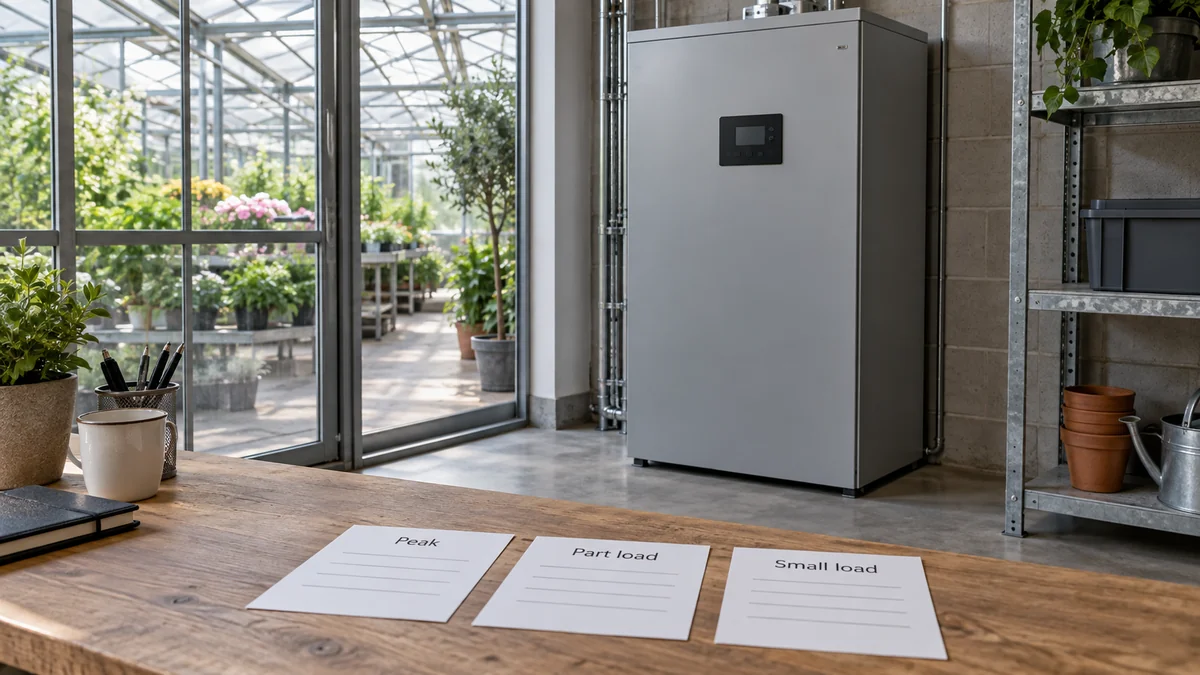
Cover peak, part-load and small-load operation
Start with the operating cases already agreed by the grower and heating designer. The greenhouse heating-load input guide helps establish the demand side. The curve review then asks whether a stated efficiency is supported for each case, without repeating the sizing calculation.
| Case | Evidence to connect | Useful review outcome |
|---|---|---|
| Peak demand | Required emitter condition, actual boiler-inlet return and firing rate | Identify the applicable curve point or request the missing condition |
| Part load | Which zones operate, their emitter requirement and the resulting inlet condition | Check whether the headline percentage represents this case |
| Small load | Proposed firing condition and whether steady operation is represented | Leave cycling or other unrepresented behavior as a separate evidence gap |
For example, imagine a proposal supports a part-load point but leaves the peak return temperature and small-load operating state blank. The result is one supported case and two unresolved cases. It is not a seasonal efficiency estimate. Ask for those two cases before treating the percentage as representative of the heating program.
Use the coverage map before accepting an efficiency assumption
Download the boiler curve and operating-case coverage map. For each row, retain the exact model, curve/version, fuel and rating basis, required emitter condition, boiler-inlet temperature, firing rate and source. Mark each condition as modeled, observed or still unknown. Add the supported chart point, the unresolved question and the person responsible for closing it.
Keep an unsupported row visible. Do not replace it with the most favorable point from another row. A useful completed review can say, “The part-load assumption is documented; peak operation needs a manufacturer response; seasonal fuel use has not been established.” That is a concrete procurement result.
A seasonal estimate needs appropriate operating weights and system losses. Taking a simple average of the chart percentages, or applying the best point to every hour, does not supply that evidence. Have the qualified heating designer connect the operating model to the applicable equipment data. Curve reading helps you review that work; it does not authorize changes to burners, flues, condensate systems, controls or an existing noncondensing boiler.