
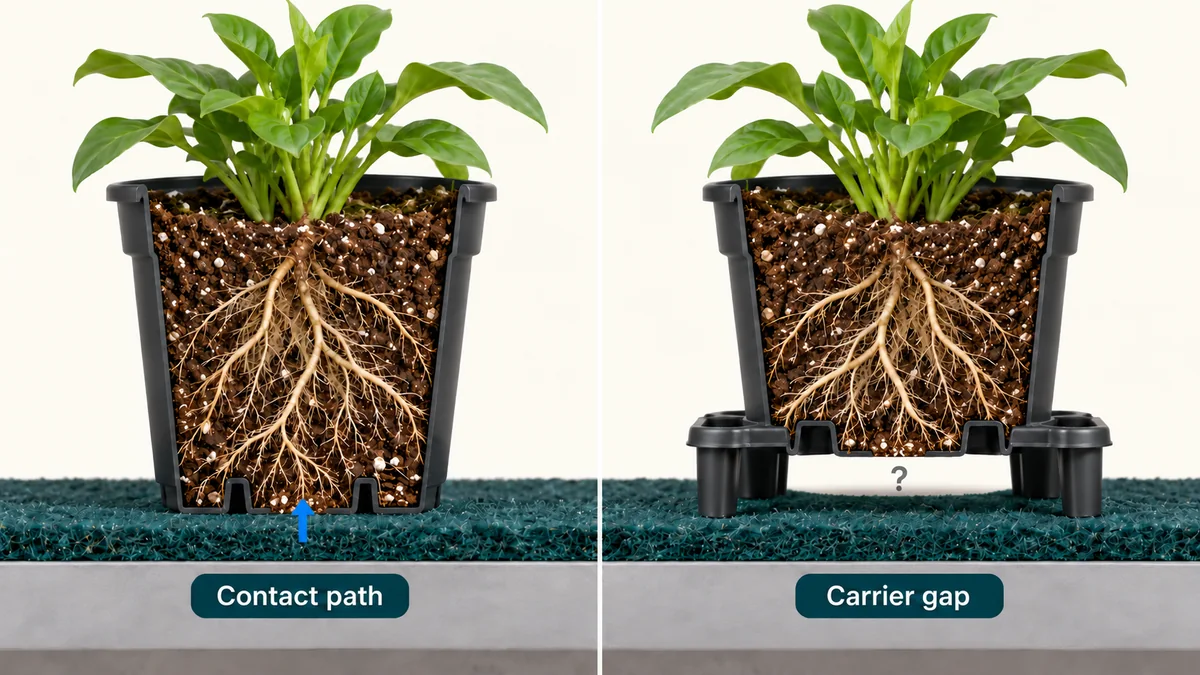
A capillary-mat purchase is ready for comparison only when the offered mat, the actual container base and the growing medium form a workable water-transfer path. A pot can fit the bench perfectly and still sit above the interface it needs. Start with a side view of the complete assembly, including any carrier tray.
This is particularly important when purchasing mats and containers from different suppliers. A top-down layout can confirm how many pots fit. It cannot show whether water reaches the medium through the base.
Follow the water across the actual pot base
In capillary subirrigation, water supplied beneath the container moves through base openings into the growing medium. A capillary mat provides the wetted distribution surface. UMass describes this bottom-up route and distinguishes mat systems from benches that temporarily contain a flooded water layer. Ordinary weed-control floor fabric is not, by its name alone, a capillary irrigation assembly. UMass subirrigation guidance explains the architectures.
For a purchasing review, trace four physical interfaces: support surface to mat assembly, mat or its specified cover to the container interface, container opening to medium, and medium to the planted root plug. The last connection matters: confirming a wet mat is not the same observation as confirming water transfer into the crop's root zone.
Look underneath the production container. A broad foot might touch the cover while an opening is recessed above it. A tray might support the pot securely but keep its base away from the intended wetted interface. These are different arrangements even when the pot's outside diameter and nominal volume match.
| What you can see | What it establishes | What remains unresolved |
|---|---|---|
| Mat surface is wet | Water is present at that observed surface | Whether it crosses the container interface |
| A pot foot touches the mat cover | There is mechanical contact at the foot | Whether the water-entry route reaches the medium |
| The actual planted assembly is assessed by the suppliers | The relevant parts and conditions can be considered together | Any crop-stage or operating conditions outside that assessment |
Ask about the named assembly, including its cover
Soleno's May 2021 Aquamat guide specifies container, substrate and open-bottom-tray conditions for that product. This is useful evidence that compatibility extends beyond ordering a roll of fabric. Its dimensional and operating conditions belong to the named system; they are not a universal allowance for gaps beneath pots. Use the Aquamat product guide to frame a supplier question, then request the current instructions for the exact offer.
Include the cover in that question. A supplier-approved cover is part of the proposed transfer interface, not an irrelevant packaging layer. Likewise, describe the supporting bench or floor and the carrier actually used. A demonstration without the carrier does not settle whether the complete production arrangement works.
Same pot diameter, different purchase conclusion
Consider a fictional comparison. Arrangement A places the intended base openings at the wetted interface. Arrangement B uses a carrier that holds those openings above it. Both quotations show the same pot diameter and the same number of pots per bench.
A has a plausible contact route to assess. B has an unresolved interruption. Neither statement is a crop-performance guarantee, but they lead to different purchasing questions. Ask the mat supplier and container supplier to evaluate B as an assembly before accepting it as equivalent to A.
Buying more square metres of mat does not remove that interruption. Extending an irrigation timer does not establish a missing physical route either. Do not cut the carrier or modify the mat from a conceptual drawing. Request a compatible, supplier-confirmed arrangement and a demonstration using production samples.
Include the condition in which the crop will use it
Provide the substrate identity and its starting moisture condition with the samples. Also identify the planted format. A supplier assessment of an unplanted pot is a different piece of evidence from an assessment that includes the actual root plug.
Follow the assembly through planned handling. Will pots start in one carrier and later stand directly on the mat? Will spacing or transfer change which base surfaces are supported? Record each materially different arrangement separately. The useful decision is whether the proposed contact route remains supported across those states, with unresolved crop questions assigned to the crop adviser.
Download the contact-path review
Download the capillary contact-path worksheet (CSV). This is a manual worksheet with no formulas. Open it as UTF-8, comma-separated text in a spreadsheet, fill the “Your assembly” column, and retain the evidence prompts. Add a separate copy for each pot–carrier combination. Sketch or photograph the underside and side view, then enter the file reference beside the relevant interface. Adjust column widths and wrapping and save a native spreadsheet copy for continued use.
Bring the completed record and actual samples to both suppliers. Ask them to identify the approved assembly and any conditions that still require demonstration before ordering.
For separate geometry and flood-system questions, see container height and root-zone air–water balance and ebb-and-flow fill volume and drain-back.