
A quotation describes an NFT channel as “food-grade PVC.” Another includes an NSF logo. Neither phrase tells the buyer, by itself, which finished part is covered or whether the evidence addresses the proposed use.
Match each wetted component to its exact identity, intended exposure and supporting evidence. Read the stated scope before treating a polymer name, authorization reference or certification as acceptance of the assembled growing system. The final applicability decision needs the responsible materials or compliance specialist.
Identify the finished parts that will be supplied
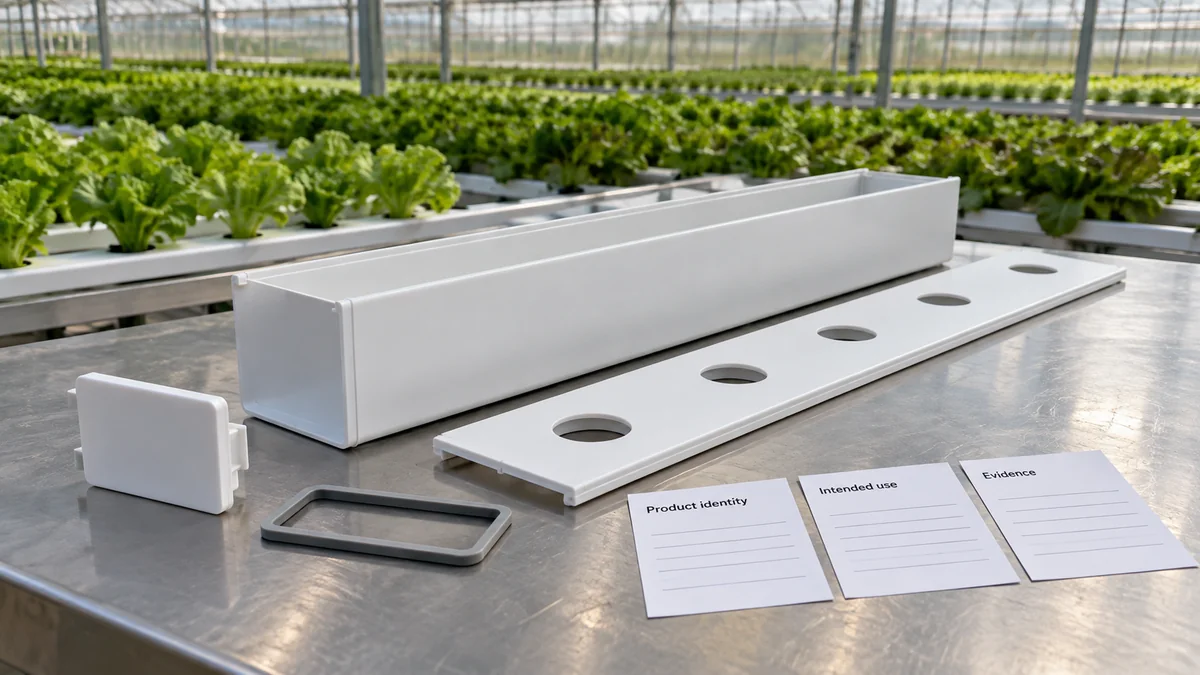
Start with the channel body, lid, end caps and any seals, joining products or adhesives that contact the nutrient solution or otherwise fall within the intended-use review. Record the manufacturer, exact product or formulation identifier where provided, and drawing or specification revision.
A resin name identifies a material family. It does not, on its own, identify every additive, finished formulation or separately sourced joint in the offered assembly. Likewise, a white surface or a statement that a plastic is virgin material cannot replace the intended-use evidence.
Ask which parts the supplier's statement covers. If a distributor substitutes an end cap or seal, that change should reopen the corresponding entry. It should not inherit the channel body's evidence merely because the parts fit together.
Food-equipment and drinking-water scopes differ
NSF's comparison of Standards 51 and 61 distinguishes food-equipment materials from drinking-water-system components. NSF/ANSI 51 concerns materials used in food equipment and related food-contact applications. NSF/ANSI 61 addresses health effects associated with drinking-water contact.
The current NSF/ANSI/CAN 61 scope page includes different component categories, including joining and sealing materials. A channel body and a separately selected seal therefore deserve identifiable evidence, rather than one undifferentiated logo beside the whole quotation.
These standards answer different questions. Do not automatically require both for every NFT purchase, and do not describe either as universal hydroponics approval. The project team must determine which requirements apply to the actual contact conditions and destination.
A useful commercial example is the GrowSpan NFT brochure, which states that its channels are NSF-certified but does not identify a standard on that page. The next purchasing question is which exact listing and product identifier support the offered channel. The brochure alone does not justify assuming NSF 61, and this observation is not a verdict about that supplier.
Map each wetted part to its intended-use evidence
Use the wetted-material evidence register with one row per component. Link each row to a detailed intended-use card when several conditions or documents need to be retained.
| Evidence field | What belongs in it |
|---|---|
| Supplied item | Exact finished channel, lid, cap, seal or joining product and its manufacturer. |
| Actual use | Contact medium, contact arrangement and relevant operating exposure supplied by the project. |
| Cleaning exposure | Approved product and method references, including any relevant conditions supplied for review. |
| Evidence basis | Specific authorization, standard, listing or manufacturer statement, with its identity and scope. |
| Limitations | Conditions the evidence covers, conditions it excludes and conditions that remain unknown. |
| Acceptance | Responsible specialist, dated decision and exact outstanding question. |
Describe the intended contact accurately. Do not relabel a recirculating nutrient solution as drinking water merely because the original incoming supply is potable. Use the relevant water-quality design inputs, together with the actual operating and cleaning conditions, in the specialist review.
The card records those conditions; it does not prescribe cleaning chemicals, migration tests or material substitutions.
Read an FDA reference as a scoped US statement
The FDA's component-status guidance says to consider substance identity, specifications and use limitations. It describes several routes by which a food-contact component can be authorized. A food-contact notification, or FCN, is not mandatory for every substance.
Where an FCN is the cited basis, FDA explains that it applies to the identified manufacturer, substance and conditions. A similar material from another manufacturer does not automatically inherit it. FDA also describes requesting a manufacturer's letter of guaranty for the intended food-contact use.
For the buyer, this means asking for the exact basis behind a general “FDA compliant” statement and having the specialist assess its relevance to the supplied formulation and actual use. It does not mean declaring that every US food-contact provision directly classifies or approves an NFT channel in every country.
A complete assembly can still have an incomplete evidence map
Imagine a hypothetical offer containing four wetted item types: channel body, lid, end cap and seal. The supplied statement identifies the body and lid. The cap is a different product code, while the seal is described only as compatible with the channel.
Two item identities are linked to that statement; two remain unresolved. That is not a “50 percent safe” assembly or a toxicology finding. It identifies the next action: obtain the cap and seal evidence and determine whether the stated use conditions cover all four items.
If the response supplies the missing identifiers but says nothing about the proposed cleaning exposure, the identity question may close while the exposure question stays open. Keep those outcomes separate so a newly received document does not erase an unanswered requirement.
Close the evidence gap before substitution
Ask the supplier to reconcile the final component schedule, current statements and any applicable listings with the order. Record the limitations accepted by the responsible specialist and retain the original evidence versions.
If a part or intended exposure changes, review that entry again. Avoid broad conclusions that all PVC is unsuitable or that every food-grade plastic is acceptable. The defensible conclusion is narrower: the identified components have, or have not yet supplied, the evidence needed for the stated project use.