

Buy compostable greenhouse clips and twine only after checking two separate conditions: the exact products can support the intended crop duty, and the actual collected waste has a confirmed receiving route. A favorable answer to either question does not close the other.
Start with the finished items on the order, including their dimensions and identity. “Biodegradable,” “industrially compostable” and “accepted by our waste contractor” describe different claims. The crop-support and disposal assumptions should be visible before a product substitution is approved.
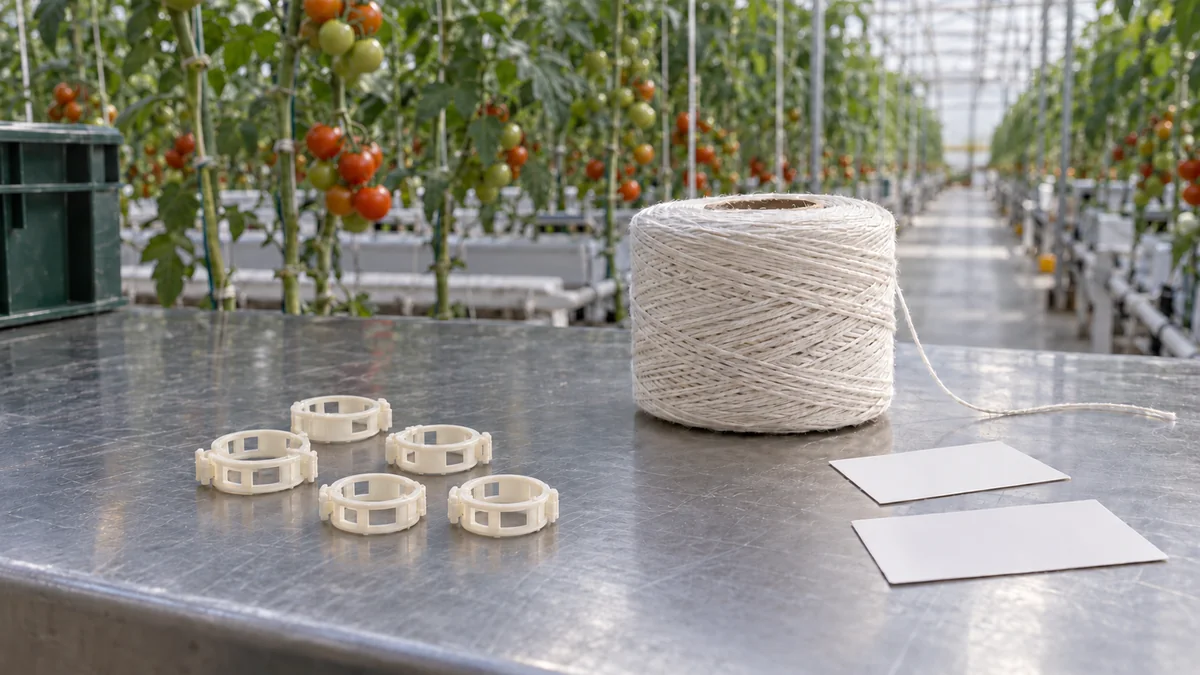
Ask the crop-support question first
Name the crop, intended support period, handling pattern and environment. Record the supplier's product code, material description, dimensions and supporting evidence. A clip or twine that performed in one crop period has not automatically been demonstrated for a different crop, longer cycle or handling arrangement.
Vineland Research and Innovation Centre reported a four-month high-wire cucumber trial, from December to April, involving specific commercially available clips and twines. The tested products supported that crop, while observations differed between materials. The report is useful product-and-duty evidence. It does not establish every compostable product's suitability or justify extending that result to an entire long tomato cycle.
Ask what your proposed duty shares with the evidence and what it changes. Keep the difference in the comparison. Do not convert a reported break-force result into a design allowable, and do not use the word “compostable” as a strength specification.
If a supplier-supported crop trial is part of the assessment, define what it is meant to establish and retain its conditions and limits. A successful short trial should lead to a bounded conclusion, not an unlimited service-life claim.
Then identify the receiving route
List the waste that would actually leave the greenhouse: crop residues, the proposed clips and twine, and any other strings, hooks, fasteners or contaminants that remain in the collected load. The receiver must assess that material stream, not just a clean product sample.
BPI's official FAQ distinguishes commercial and home compostability certification and explains that certified scope can depend on the finished item and its maximum thickness or grammage. It also discusses why composters may decline certified compostable products. A certificate therefore needs to be checked against both the exact item and the proposed destination.
Where BPI certification is claimed, use its certified-product catalogue to identify the product and scope, then retain the relevant record. This article has not verified certification for a particular clip or twine being offered to your project.
Ask the named receiving facility to confirm acceptance of the described waste mix, including exclusions and collection requirements. Record who will arrange segregation and what route applies if the load is rejected or the proposed receiver is unavailable. Certification alone is not an instruction to put an item into soil, home compost or an anaerobic-digestion stream.
A real product application still needs a local route
BASF's February 2025 release describes an industrial-composting application for greenhouse support clips. It establishes a real commercial example. It does not confirm the identity of another finished product, the performance of your crop-support arrangement or acceptance by your receiving facility.
Keep the chain of evidence intact: supplier product identity, claimed certification scope, actual mixed waste and receiver response. An approval for a resin should not be treated as coverage for any finished item made with it.
| Crop-support evidence | Waste-route evidence | Purchasing conclusion |
|---|---|---|
| Supported for the stated duty | Receiver acceptance unresolved | The intended disposal route remains unconfirmed. Resolve it or evaluate a defined fallback. |
| Longer or different crop duty unresolved | Receiver accepts the specified waste mix | The disposal answer does not establish support performance. |
| Supported within stated conditions | Accepted within stated conditions | Assess the complete offer while retaining both sets of conditions. |
How the two-condition check changes a decision
Imagine a hypothetical twine offer with relevant crop-support evidence and a stated industrial-compostability certification. The greenhouse plans to collect it with crop residues, but the proposed facility has not agreed to receive that mix. The next action is to obtain the facility's response or assess another permitted route. It is too early to include a disposal saving in the comparison.
In a second hypothetical offer, the receiver accepts the identified finished items with the described residues. The only crop evidence, however, covers a shorter period than the buyer plans. That offer remains open on the service side. Ask the supplier for evidence covering the intended duty or a properly bounded assessment plan.
Neither case says the product is unsuitable. Each identifies the specific unanswered condition that a broad “green product” label would conceal.
Return a precise product-and-route question
Use the support-duty and waste-route purchase sheet. It is a manual record with two conclusions and no overall green score. Fill the intended crop duty and waste composition first, then identify the evidence for each offer.
Mark each condition as supported within stated limits or unresolved, with its evidence reference and next owner. Keep any fallback route explicit. The separate crop-changeover guide addresses removal and hygiene planning once the product and disposal assumptions are established.
Before ordering, ask the supplier and receiver to answer the open rows. The result should be a traceable decision about a named support product and a named material stream, with neither crop performance nor disposal acceptance left to the label alone.