
The short answer
Begin with separate performance duties: night heat retention, daytime solar reduction, light diffusion, blackout, humidity management, or a combination. Provide local design climate, crop and stage, target light range, heating strategy, ventilation arrangement, greenhouse geometry, structural support points, fire and insurance requirements, control sequence, and maintenance access. Require certified fabric data and a coordinated drawing of the complete retractable system.
A high nominal shade value can reduce useful crop light, while an energy fabric installed with open edges can allow warm air to bypass it. One fabric may perform several duties, but the project should not assume that a single layer will satisfy every seasonal objective without tradeoffs.
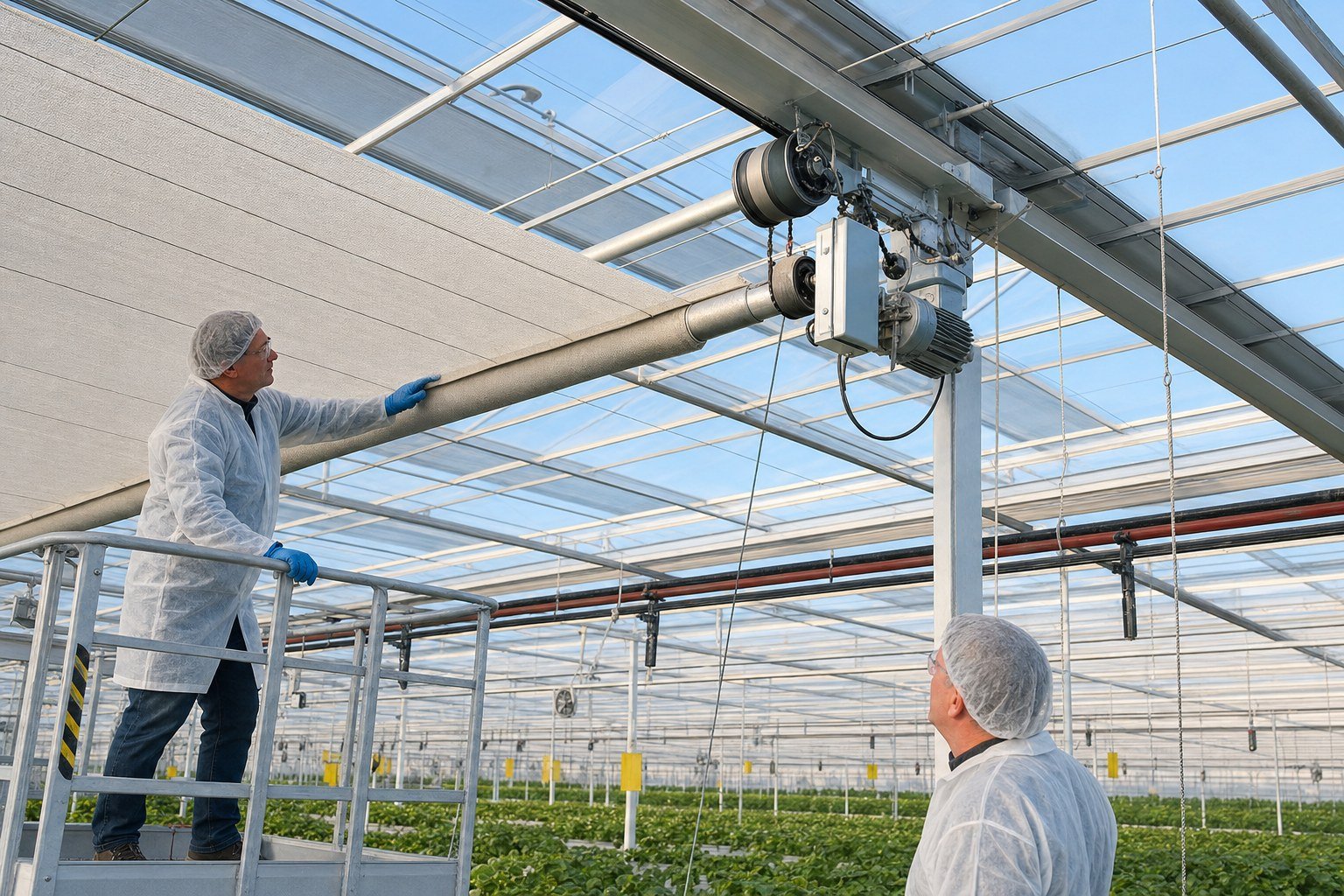
The screen package occupies valuable space near trusses, gutters, vents, heating pipes, irrigation mains, lighting, hanging systems, and circulation fans. If these interfaces are left until installation, the result can be restricted screen travel, inaccessible equipment, trapped water, fabric damage, or a system that never closes tightly.
This planning guide supports procurement and coordination. Project-specific values and safety decisions remain with the grower, qualified designers, equipment manufacturers, contractors, and authorities responsible for the installation.
Inputs that should be fixed before supplier selection
| Input group | Record | Decision supported |
|---|---|---|
| Purpose and season | Night energy retention, summer shade, diffusion, blackout, humidity strategy, crop stage, operating months, and expected daily cycles. | Separates functions that require different fabrics or control rules. |
| Fabric performance | Open or closed construction, solar and light transmission, reflection, energy-saving test basis, fire classification, condensation behavior, durability, warranty, and cleaning limits. | Makes supplier comparisons traceable to stated methods. |
| Geometry | Bay and span dimensions, truss level, gutter details, slope, storage bundle, travel direction, overlaps, perimeter seals, partitions, and obstruction survey. | Determines material quantity, closure quality, and compatibility. |
| Mechanics | Drive type, motor, gearbox, shafts, racks or cables, supports, tension, limit devices, manual recovery, cycles, corrosion protection, and spare parts. | Defines reliability and maintainability of the moving system. |
| Controls and acceptance | Triggers, hysteresis, wind and snow logic, vent interlocks, staged movement, alarms, current monitoring, full-cycle tests, closure inspection, and documents. | Connects performance claims to site operation. |
Identify each provisional item and the date by which it must be closed. A supplier can offer alternatives, but each alternative should state which input changed and how that change affects capacity, layout, utilities, controls, maintenance, and price.
A practical design and review sequence
1. Write a seasonal operating narrative
Describe when the screen is expected to close, partially deploy, open, or remain locked out. Include cold nights, sunny winter mornings, summer radiation peaks, high humidity, irrigation, strong wind, snow risk, fire response, cleaning, and power failure. This narrative is more useful than asking for an automatic screen without defining automatic behavior.
2. Choose fabric against crop and climate data
Provide crop light limits, desired diffusion, local radiation, heating period, night temperature, and humidity strategy. Request the test method behind transmission, reflection, shade, and energy values. Confirm whether the stated percentage describes photosynthetically active radiation, total solar energy, or another measurement. They are not interchangeable.
3. Coordinate the installed envelope
Review edge closures at sidewalls, gables, gutters, posts, and partitions. Warm air that rises above a thermal screen can escape through gaps. At the same time, the design must manage condensation and allow safe movement. Locate heating and water services with respect to the closed screen and protect the fabric from hot surfaces, leaks, abrasion, and sharp edges.
4. Inspect every operating state
Test repeated full cycles, intermediate positions, end limits, synchronization, abnormal resistance, manual recovery, alarms, and restart after power loss. Observe fabric tracking across the entire range, not only at the drive end. Confirm vents, fans, lighting, irrigation, and hanging equipment remain usable in all screen positions.
Keep the assumptions with the calculation or equipment schedule. When the crop plan, source condition, greenhouse geometry, or operating sequence changes, the responsible designer can then identify which result must be recalculated instead of relying on an obsolete approval.
Divide responsibilities at the interfaces
Owner and grower
Provide crop, operating hours, acceptable risk, local practices, staff capability, utilities, expansion plan, and approval priorities.
Greenhouse supplier
Provide structure, envelope, equipment, layout, loading, utility, control, installation, and commissioning interface data within the contracted scope.
Specialist designer
Apply local climate, codes, calculation methods, safety duties, equipment selection, system integration, and professional approval.
Contractor and operator
Confirm site conditions, installation, access, testing, records, training, safe operation, inspection, and maintenance.
Use a responsibility matrix for supply, design, installation, power, water, drainage, controls, network, civil works, testing, permits, consumables, spares, training, and warranty response. Phrases such as complete system are not enough when the interfaces cross several contracts.
Common specification failures
| Failure | Why it matters and what to do |
|---|---|
| One percentage defines the purchase | A shade number alone omits spectral basis, energy function, openness, diffusion, fire behavior, and installed closure. Compare complete certified data and intended duty. |
| Gaps are treated as cosmetic | Open perimeter and internal joints allow heat and light bypass. Detail seals and overlaps while preserving movement, drainage, and safety. |
| The truss zone is already occupied | Late screen design collides with pipes, lights, ducts, fans, crop wires, or maintenance platforms. Freeze a coordinated services section before purchasing. |
| Controls ignore other systems | A screen that closes against open vents, blocks heat distribution, or traps excessive humidity creates new problems. Define interlocks, staged responses, and operator override. |
Record every accepted deviation. A verbal clarification during a meeting should be transferred to the controlled drawing, schedule, calculation, or specification that governs manufacture and site work.
Plan acceptance before equipment is ordered
Agree on document review, factory checks where appropriate, delivery inspection, installation inspection, pre-start checks, calibration, functional tests, representative operating tests, abnormal-mode tests, training, and handover. State the instruments, conditions, tolerances, data format, witnesses, and corrective-action process.
Use the project commissioning plan to connect design intent to field evidence. Where continuity matters, coordinate power, alarms, operator response, and recovery through the site resilience plan. Keep final settings, test results, and approved changes with the equipment record so maintenance staff have a usable baseline.
Acceptance is not a substitute for ongoing observation. Trend the measurements that reveal deterioration, compare them with the commissioned condition, and define who investigates a sustained change. This is particularly important where crop damage can begin before a component reaches complete failure.
Questions the project team should answer
What does each screen layer need to do in each season? Which crop and light target govern selection? Which climate data and heating mode support the energy case? What fire classification is required by the authority, insurer, and owner? Where will the fabric store when open? How are edges sealed? Which equipment crosses the screen plane? How will the system recover from power loss, skew, torn fabric, or a failed drive?
Frequently asked questions
Can one screen provide both shade and heat retention?
Some fabrics combine functions, but the balance may not suit every crop and season. Compare the required light, solar, thermal, moisture, and blackout performance, then decide whether one or two independently controlled layers are justified.
Should a screen be installed gutter to gutter or truss to truss?
Both arrangements can work. The choice affects heated volume, material area, storage bundle, service coordination, crop clearance, installation height, and edge closures. Select it from the greenhouse section and equipment layout.
Is an estimated energy-saving percentage a guarantee?
No. Fabric test results and estimates do not guarantee project savings. Actual performance depends on weather, greenhouse tightness, screen closure, heating efficiency, setpoints, operating hours, and maintenance.
What should be included at handover?
Provide approved drawings, fabric certificates, motor and gearbox data, control sequence, limits and settings, test records, manuals, cleaning guidance, warranty, spare parts, and a safe method for inspection and repair.
Prepare the input schedule before requesting a fixed offer
Send the greenhouse section, bay dimensions, crop and light targets, local climate, heating system, ventilation arrangement, fire requirements, service layout, and seasonal operating plan. Chengfei Greenhouse can coordinate the screen package with the greenhouse structure and control interfaces.
Contact Chengfei GreenhouseReferences
- Selecting an Energy/Shade Screen System. Selecting an Energy/Shade Screen System.
- Energy Conservation Checklist. Energy Conservation Checklist.
- Regulations and Codes Related to Commercial Greenhouse Construction. Regulations and Codes Related to Commercial Greenhouse Construction.