
The pressure number printed on a PVC irrigation pipe belongs to a defined product and rating basis. It should not be treated as an unconditional limit for every temperature and every component in a greenhouse irrigation assembly.
Before approving a new line or a change in operating duty, ask the responsible supplier or designer to compare the actual conditions with the applicable pipe, fitting, joint and valve documentation. This is especially important where water temperature or exposed sections differ from the conditions assumed when the system was selected.
Keep the three temperature questions separate
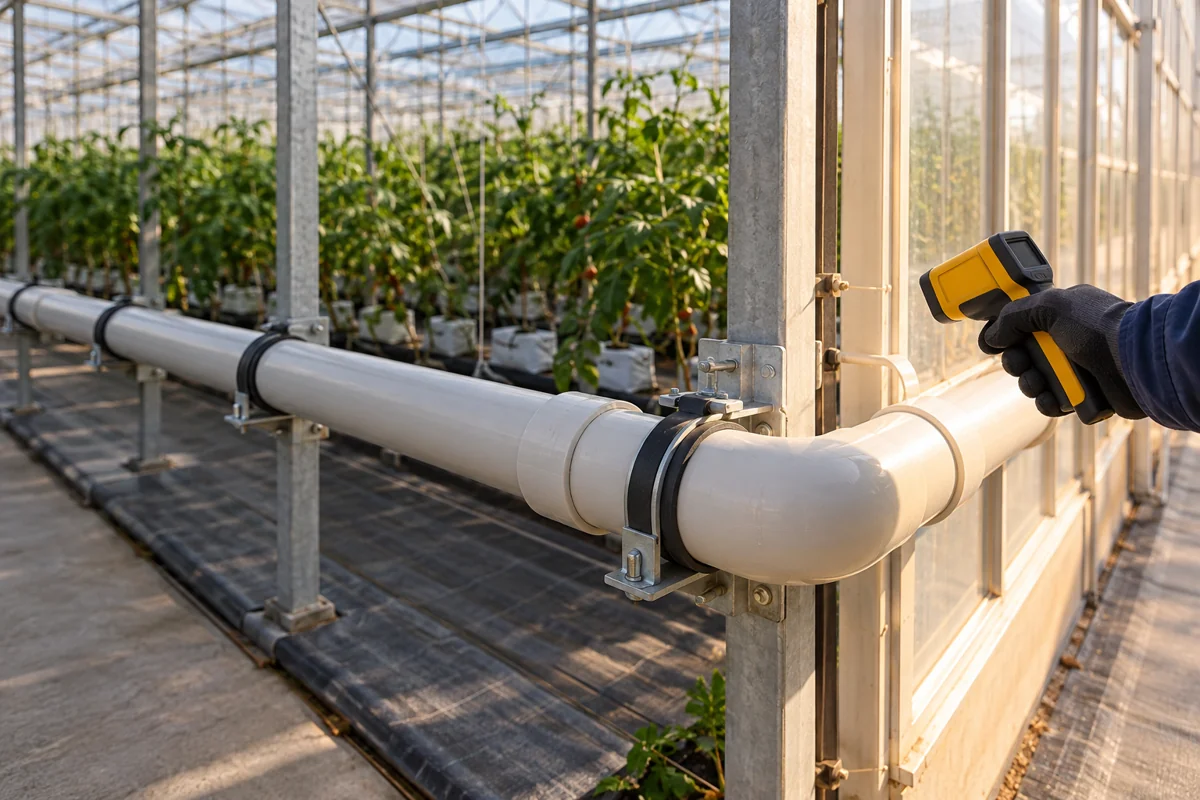
Record the water temperature, the surrounding environment and any available information about the pipe itself. A greenhouse air sensor, a tank reading and a measurement on an exposed pipe describe different locations. Do not substitute one for another without an accepted engineering basis.
Identify sections exposed to sunlight or other heat sources, and note whether the line is flowing or sitting between irrigation cycles. The hottest relevant operating condition may not be represented by a convenient reading during a short visit.
Westlake Pipe and Fittings' temperature guidance for PVC piping explains that pressure ratings have a reference-temperature basis and discusses derating at elevated temperatures. Its published factors and conditions must be checked for the actual product and service. They are not a universal table for every plastic irrigation line.
Identify the product before selecting a chart
Collect legible markings, original purchase records and the current manufacturer's data. Record the material designation, product standard, dimensions and pressure designation. A description such as “PVC main line” is not enough to select the correct pressure-temperature information.
Keep PVC-U, PVC-C and other piping materials distinct. Do not combine a chart from one material with fittings or a pipe from another simply because the dimensions appear similar. A product family name also needs to be tied to the exact item and size being reviewed.
Where markings are unavailable, record that uncertainty and ask the supplier how identification can be established safely. Do not infer a rating from color, appearance or an informal statement about wall thickness.
Review the assembly component by component
A line may contain pipe, elbows, tees, unions, adapters, valves, filters and different joint systems. Obtain the applicable limits for each item. The rating printed on the pipe does not establish the suitability of everything connected to it.
GF Piping Systems' planning guidance gives conditions for its PVC-U pressure-temperature diagrams and directs users to separate information for valves and special fittings. Construction and sealing materials can affect the limits. The designer must determine which documented limitation governs the proposed assembly.
Also identify the fluid service. Irrigation water, nutrient solution and maintenance chemicals should not be grouped under a vague “water use” label. Give the responsible supplier the relevant chemical information, concentrations, temperatures and exposure conditions through the farm's approved technical process. This article makes no chemical-compatibility recommendation.
Prepare a rating-versus-duty sheet
| Item | Catalog or design basis | Actual duty and evidence |
|---|---|---|
| Pipe manufacturer, product and material | ________ | ________ |
| Standard, size and schedule or dimension ratio | ________ | ________ |
| Reference pressure rating and temperature basis | ________ | ________ |
| Applicable pressure-temperature document and revision | ________ | ________ |
| Normal and maximum relevant fluid temperature | ________ | ________ |
| Ambient exposure and exposed line sections | ________ | ________ |
| Working pressure and operating sequence | ________ | ________ |
| Surge or other transient review | ________ | ________ |
| Fittings, valves, seals and joint identification | ________ | ________ |
| Fluid and chemical-service information | ________ | ________ |
| Installation, support and change history | ________ | ________ |
| Supplier or designer decision and open conditions | ________ | ________ |
Write the units beside each pressure and temperature entry. Identify whether a value was measured, taken from a design, copied from a product document or assumed for planning. Keep the instrument location and observation period with each measurement.
An unresolved cell is an open item. It is not evidence that the installation has passed. Assign the missing information to a named person and state whether procurement or the proposed operating change depends on it.
Do not confuse steady duty with transient pressure
A temperature-adjusted pressure review still needs the system's operating sequence. UF IFAS explains in Water Hammer in Irrigation Systems that sudden flow changes, including pump and valve operation, can create pressure surges. A normal running-pressure reading does not establish the largest transient the system experiences.
Have the irrigation designer address transient conditions separately and explain how they are included in the assembly review. This article focuses on whether the material and rating data apply to the duty. It does not provide a valve-closing schedule, a surge calculation or a pressure-test method.
Do not deliberately create a pressure event to collect evidence. Use existing records and installed monitoring within approved operating procedures. Any additional testing requires a qualified plan suitable for the system.
Compare corrective options using the same duty
If the existing selection is not supported, ask for alternatives assessed against the same conditions. An alternative could affect material choice, route, environmental exposure, system operation or other design details. The supplier should explain what changes and what still needs approval.
A thicker-looking component, a higher nominal pressure class or a change in material should not be accepted on appearance alone. Request the applicable product evidence, joint compatibility and installation requirements for the proposed assembly.
For an existing line with leakage, deformation or suspected damage, keep people clear and follow the site's shutdown and isolation procedure. Qualified personnel must determine the safe response. Do not tighten fittings, cut pipe, make repairs or open the line while it is pressurized.
Keep the accepted operating envelope with the system
At the end of the review, retain the component list, relevant pressure-temperature documents, measured or approved duty and the designer's decision. Record any conditions on operation and how they will be monitored.
Revisit the review when the water source, temperature, chemicals, pump settings or layout changes. A past acceptance applies to its documented basis. The useful outcome is a traceable explanation of why the entire irrigation assembly suits the intended duty, rather than a pressure number detached from the conditions that give it meaning.
Download the working files
Use these CSV files with the instructions in this article.