
The cold-room display reaches its setpoint while fruit in the middle of a pallet remains warm. The room may be doing its holding job, yet the incoming harvest is not cooling quickly enough. Air temperature alone cannot show that field heat has been removed from the produce.
Precooling removes heat from newly harvested product; cold storage maintains suitable conditions afterward. One installation may perform both functions if designed for them, but a room sized only to hold already cool produce should not be assumed to handle a large warm harvest peak.
Define the product before the room temperature
Crop, cultivar where relevant, maturity, packaging and destination determine the appropriate temperature range and handling method. Lettuce, cucumber and tomato should not automatically share one low-temperature program. Obtain commodity-specific guidance and customer specifications, including sensitivity to chilling and dehydration.
UC Davis postharvest training explains the role of cooling and temperature management in preserving quality. The practical design implication is to define the required product condition and timing before selecting a cooling method.
Ask where the air actually goes
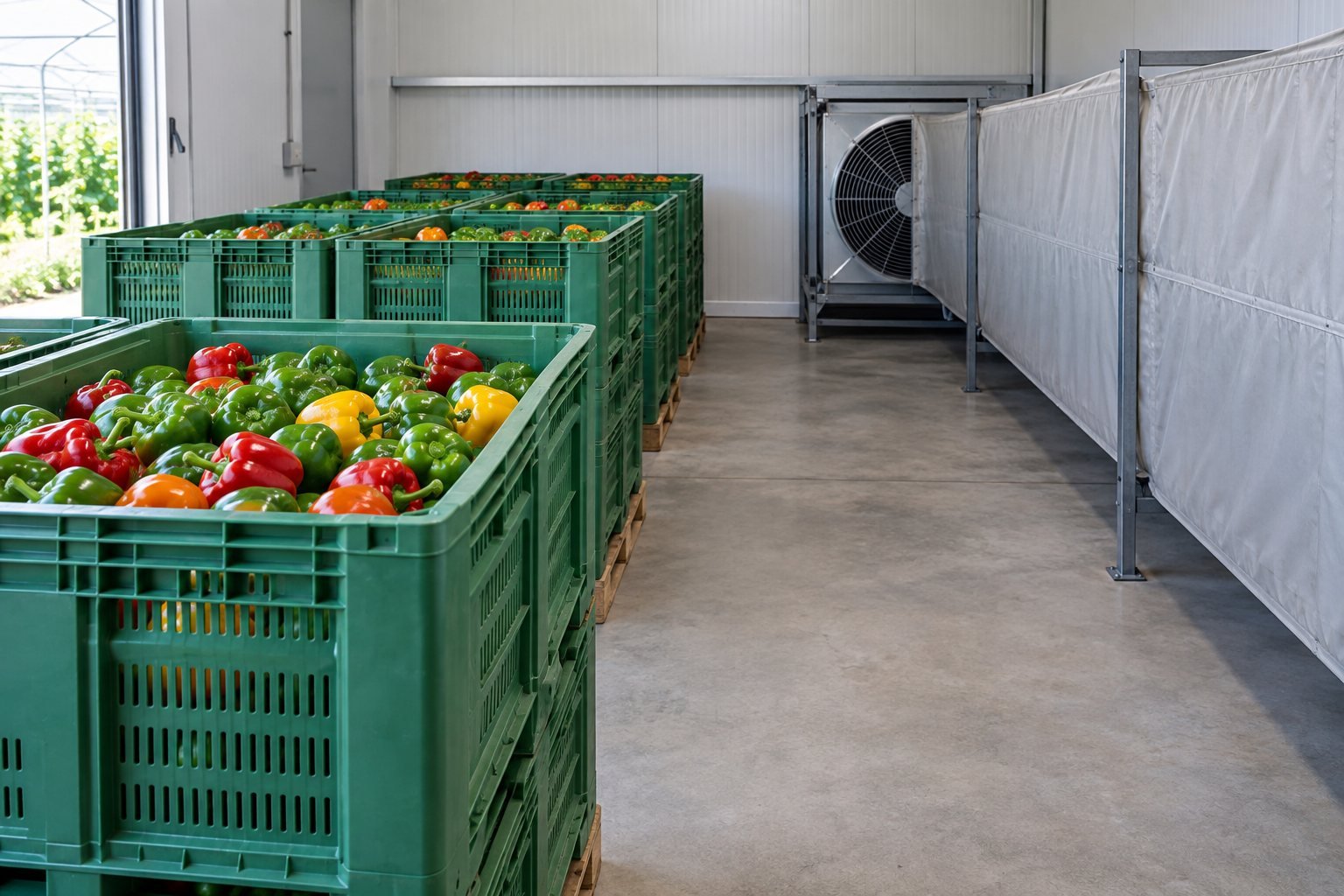
Room cooling relies on heat moving from the produce into the surrounding cold air. Forced-air cooling deliberately draws air through appropriately vented packages using a pressure difference. NC State's forced-air cooling guide emphasizes airflow through the load and sufficient refrigeration capacity to remove the transferred heat. Adding a fan does not create extra refrigeration capacity by itself.
| Design question | Evidence to request | Potential failure |
|---|---|---|
| Can air pass through the package? | Vent locations, liners and loaded stacking arrangement | Cold air bypasses the product |
| Can the room remove the incoming heat? | Peak load calculation including product, doors and equipment | Air temperature rises as warm harvest enters |
| Does the center cool in time? | Product-temperature records at representative difficult positions | A cold outer crate hides a warm core |
| Does handling preserve the result? | Transfer and dispatch sequence | Product warms again while waiting outside |
Use the busiest harvest interval
Annual production says little about hourly cooling demand. Estimate kilograms arriving per hour during the busiest realistic picking window, their starting temperature and the required cooling completion time. Include overlapping batches and interruptions for cleaning or loading.
A hypothetical energy check illustrates the scale: cooling 1,000 kg of produce through 15 C with an assumed specific heat of 3.8 kJ/kg/C requires about 57,000 kJ, or 15.8 kWh, for the product alone. Removing that in two hours implies an average product load of about 7.9 kW. The assumed specific heat must be replaced with the relevant commodity value; this excludes packaging, infiltration, respiration, equipment heat and other loads, so it is not a refrigeration selection.
Verify product temperature and handling time
Agree on a clean, suitable measurement procedure that does not compromise food safety. Record harvest time, arrival time, cooling start, representative product temperatures and dispatch. Use calibrated instruments and document where measurements were taken.
Assess both slow-cooling positions and any risk of overcooling sensitive product. Follow commodity and food-safety guidance when considering water-based cooling; neither greenhouse irrigation-water suitability nor visual clarity establishes suitability for postharvest contact.
Connect harvest capacity to cooling capacity
A greenhouse expansion that doubles peak harvest flow may require changes outside the growing area. Check trolley routes, temporary staging, packaging supply and dispatch before assuming that an existing cold room can absorb the increase.
The tomato yield-planning guide distinguishes production assumptions from guaranteed output. For CFGET project planning, provide a peak harvest-flow estimate and the cooling brief to the specialist responsible for refrigeration. The useful next step is a product-flow and temperature plan, not selecting the coldest room on the quotation.