

A valve can match the pipe connection and nominal size while remaining unsuitable for a greenhouse irrigation duty. Its operating mechanism may depend on inlet pressure or a pressure difference that the system does not provide in every state. A catalog's maximum pressure is only part of the selection.
Before ordering, compare the exact liquid-service valve with the actual upstream and downstream conditions. Include startup, the smallest operating zone and any gravity-fed or low-pressure supply arrangement. Keep unknown conditions visible until the qualified irrigation designer resolves them.
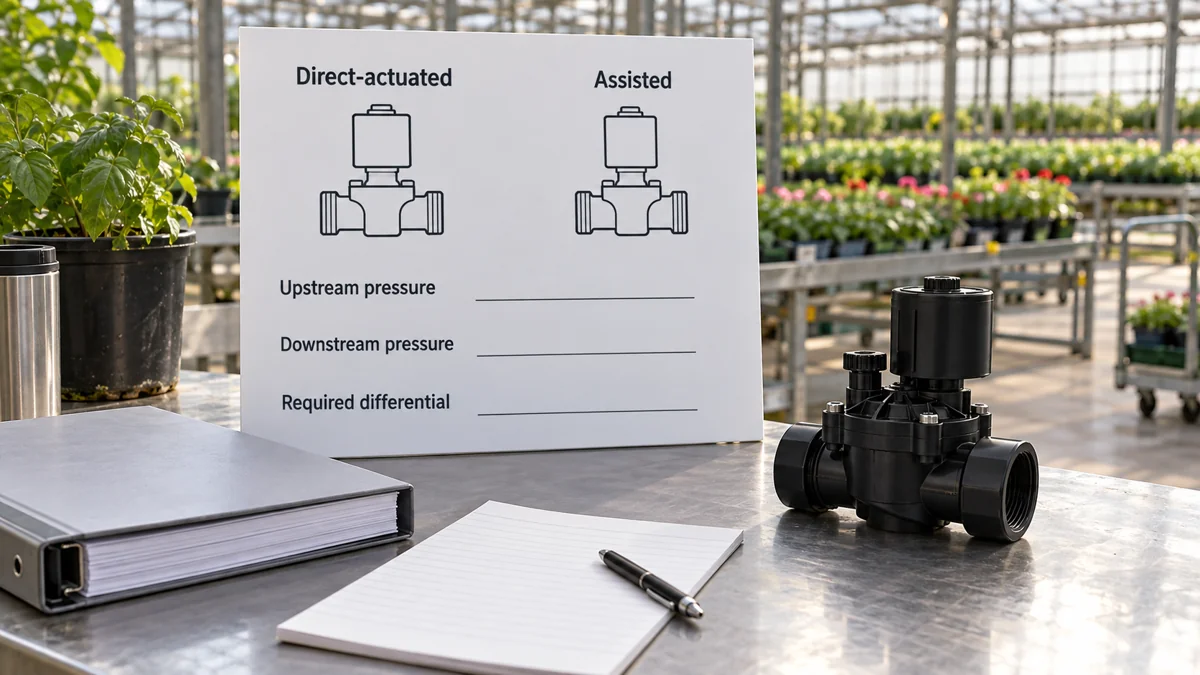
Ask which pressure the document means
Inlet pressure, differential pressure and maximum working pressure are different entries. Differential pressure describes the pressure difference between the stated upstream and downstream points. A sufficiently high inlet reading does not, by itself, establish that the required difference exists across the valve.
The BERMAD IR-170-55-bD product sheet, for example, separately identifies a pressure rating, an operating-pressure range and flow-related information. Those fields answer different questions. This example is not a recommendation to use that model or its values in another irrigation system.
On the proposal, require the supplier to name the pressure reference and the conditions attached to each limit. “Suitable for low pressure” is not a complete selection statement.
The mechanism matters as much as the connection
Solenoid describes the electrical actuation, but it does not mean every valve works hydraulically in the same way. Manufacturer ranges include different direct-acting and assisted mechanisms. Some models require a differential for a stated function, while others can actuate without a minimum differential under their documented conditions.
A particularly useful caution appears in Bürkert's Type 6213 data sheet. Its opening description includes a spring-coupled design, while the standard liquid-service description also specifies that a minimum differential is needed for full opening. The distinction between beginning to open and achieving the documented full-open condition matters. Read the variant and footnotes, not just the headline.
Do not transfer a statement about a gas or vacuum variant to irrigation water. Confirm the exact article number, fluid, seals, coil and operating conditions. A zero-minimum-differential feature also does not create the hydraulic energy needed to deliver water through the rest of the system.
Describe the difficult operating states
Make a short list of the states the valve must handle. The list should reflect the approved system sequence rather than a new experiment:
- Starting irrigation from the normal resting condition
- Supplying the smallest intended zone
- Operating with other permitted zones or equipment
- Using each approved source and its documented pressure range
- Stopping and recovering through the approved sequence
For each state, provide upstream pressure, downstream pressure and flow where known. Use readings from suitable installed instruments or measurements arranged by qualified personnel. Identify whether the values are measured, calculated or provisional.
A valve beside the pump may experience different conditions from one farther along the distribution line. Use the proposed valve location in the review. Do not replace a missing downstream value with an assumption that the outlet is freely discharging.
Compare the duty against the exact product
| Selection item | Required duty or observed condition | Exact valve evidence and open issue |
|---|---|---|
| Valve location, function and operating states | ________ | ________ |
| Manufacturer, article number and manual revision | ________ | ________ |
| Operating mechanism and liquid-service suitability | ________ | ________ |
| Normal state and required failure response | ________ | ________ |
| Minimum inlet pressure, where specified | ________ | ________ |
| Required differential for opening and full opening | ________ | ________ |
| Maximum working pressure and applicable conditions | ________ | ________ |
| Upstream and downstream range for each operating state | ________ | ________ |
| Required flow and documented pressure loss | ________ | ________ |
| Fluid, temperature and sealing materials | ________ | ________ |
| Flow direction and permitted installation arrangement | ________ | ________ |
| Coil, supply and controller compatibility | ________ | ________ |
| Maintenance requirements and safe access | ________ | ________ |
| Supplier decision, conditions and reviewer | ________ | ________ |
If a product document does not state a required minimum differential, record “not established” and ask the manufacturer. Do not infer a value from another model, a reseller's general description or the valve's physical size.
Keep the control and hydraulic questions connected
Check what the specified normal state means for the exact valve and what happens under the identified failure. Loss of an electrical command, loss of supply power and loss of hydraulic pressure are different events. The designer should confirm the response required by the crop-protection plan and whether the proposed valve provides it.
Likewise, matching the coil label to a controller output is a documented compatibility check. It is not an instruction to energize a loose coil or probe a live control circuit. Electrical testing belongs to qualified personnel using the applicable procedure.
When a valve already installed in the greenhouse behaves inconsistently, preserve the symptom and operating-state record. A click or controller command does not demonstrate the required water delivery. The service team must separate electrical command, valve response and hydraulic performance.
Choose an alternative only after the mismatch is clear
If the pressure envelope is unsuitable, request an alternative selected for the same required flow and operating states. Ask the supplier to explain the mechanism and supporting evidence. A different nominal size or an advertised low-pressure option should not bypass the rest of the comparison.
The review should also keep transient-pressure questions with the irrigation designer. Do not reproduce a fault by rapidly closing a valve, changing pump settings or creating an unapproved zone combination. This article provides no universal pressure setting or surge test.
Do not dismantle a pressurized valve, loosen fittings or carry out energized-coil tests to complete the sheet. Use the site's shutdown, isolation and service arrangements if inspection is needed.
The purchasing decision is ready when the supplier can show that the identified valve performs its required function across the documented duty. Connection size gets the valve into the drawing. Its pressure envelope determines whether the selection is supported.
Download the working files
Use these CSV files with the instructions in this article.