
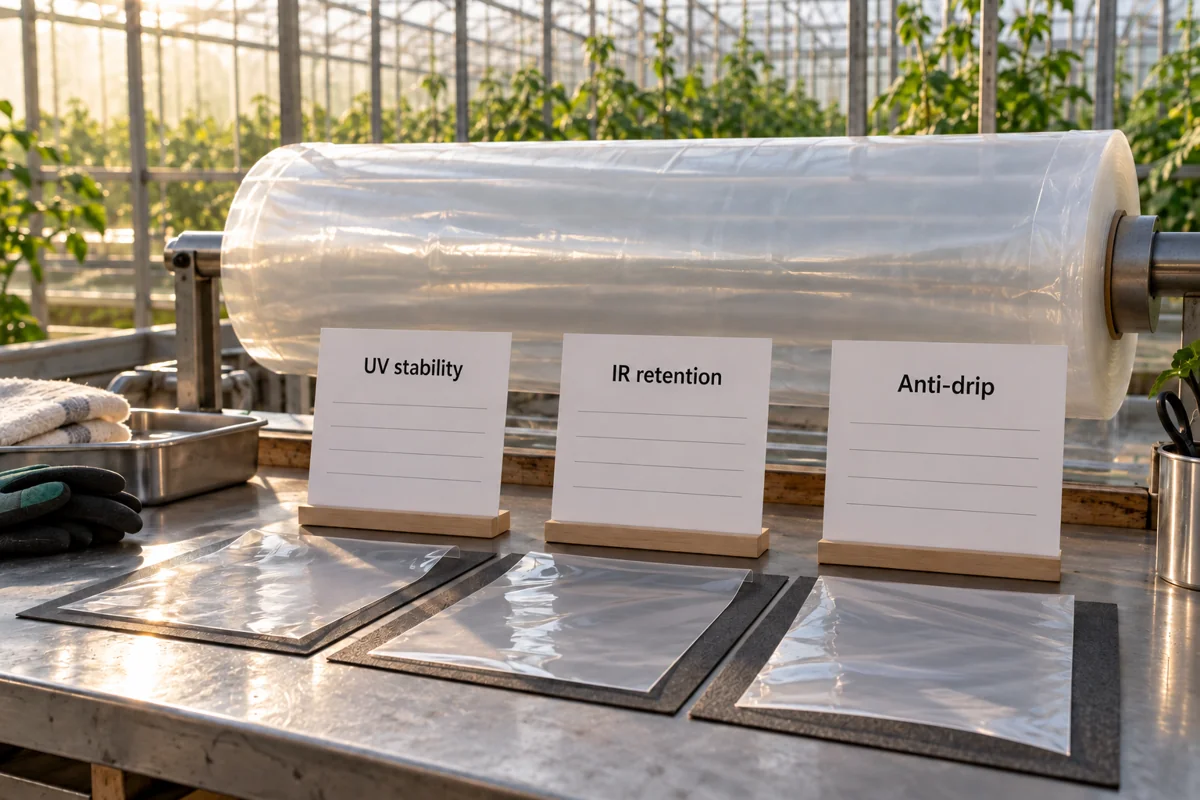
A greenhouse film label may promise UV protection, IR performance and anti-drip behavior on the same roll. Those terms answer different purchasing questions. Before ordering, separate protection of the plastic itself, the wavelengths reaching the crop, heat leaving the house and the way condensed water moves across the cover.
The practical goal is a specification you can check against the delivered product. Start with the production problem you want to solve, then ask for the relevant evidence. A longer list of additives does not, by itself, identify the right film for your greenhouse.
What does “UV protected” actually protect?
UV stabilization concerns the film's resistance to degradation. UV transmission concerns the radiation passing through it. A statement about one does not establish the other. Virginia Tech's review of greenhouse glazing discusses both UV-related material deterioration and the effects of transmitted wavelengths on the crop environment.
For stability, request the product's intended exposure conditions, test method, aging basis and applicable warranty. For transmission, ask for a spectral curve or a defined transmission value with its wavelength range. A brochure saying “UV film” leaves both questions open.
Put your crop and pollination system on the inquiry. UMass Extension notes that UV transmission can matter when bees are used for pollination. That warrants a discussion with the crop adviser and pollination supplier, rather than assuming the strongest UV-blocking claim suits every crop. See its plastic greenhouse film guidance.
Does the IR claim concern nighttime heat loss or incoming sunlight?
Ask the supplier to spell out “infrared.” Thermal or long-wave IR retention concerns radiation emitted by surfaces inside the greenhouse. A film designed for that function can reduce radiative heat loss. Solar near-infrared rejection addresses part of the incoming sunlight and is used to limit daytime heat input. These are different spectral functions. UMass separates nighttime heat-retention additives from near-infrared treatments for daytime heat gain; the NSW Department of Primary Industries and Regional Development describes long-wave absorbers that reduce loss of heat radiated from internal objects.
For a heated winter crop, request the long-wave test result and the covering configuration to which it applies. For a hot-season crop, request near-infrared and crop-light transmission data together. “IR blocking: high” is insufficient without the spectral band and measurement method.
Keep any proposed heating or cooling benefit in a separate project assessment. The film datasheet cannot establish your annual energy saving without assumptions about climate, operating temperatures, screens, ventilation and the installed covering system. Do not turn an optical percentage into a fuel-saving percentage.
Will anti-drip film remove humidity?
Anti-drip describes surface wetting behavior. It encourages condensate to spread or run instead of collecting as drops that fall onto the crop. Water vapor can still condense on a cool cover. UF/IFAS explains the condensation mechanism and the role of anti-condensate greenhouse films. Treat anti-drip as management of liquid water on the film, not a dehumidification capacity.
Ask which surface must face the crop, how that surface is identified, and what installation and operating conditions support the effect. Ask separately how long the anti-drip property is specified to perform. Do not assume the structural film warranty also guarantees every additive's performance for the same period.
The GHL installation guide for Klerk's film illustrates why instructions must match the product: it specifies placement for its K-50 IRAC film and discusses conditions affecting anti-condensation behavior. Use the current instructions supplied for your exact roll, rather than transferring that product's arrangement to another film.
Use this worksheet before comparing quotations
Download the film datasheet review worksheet. It contains paired rows for Product A and Product B under each property. Add more products by copying rows. Keep the manufacturer's original wording in the stated-value field and put your interpretation in the crop-relevance field.
First record the supplier, exact product code, thickness, datasheet revision and intended layer position. Then complete every field below for each property. Write “not supplied” for missing evidence and “not applicable, because…” where appropriate. Blank cells should remain visible questions, rather than silently becoming acceptable answers.
| Review field | Product A | Product B |
|---|---|---|
| Property and stated value | Property: ____ Value or wording: ____ | Property: ____ Value or wording: ____ |
| Units, wavelength range and test method | ____ | ____ |
| Aging or exposure condition | New / aged: ____ Condition: ____ | New / aged: ____ Condition: ____ |
| Side orientation and layer position | ____ | ____ |
| Warranty coverage and exclusions | Document / clause: ____ | Document / clause: ____ |
| Relevance to this crop and season | ____ | ____ |
| Missing evidence and responsible contact | Question: ____ Contact: ____ | Question: ____ Contact: ____ |
| Evidence location and decision | File / page: ____ Accept / clarify / unsuitable: ____ | File / page: ____ Accept / clarify / unsuitable: ____ |
Check comparability before ranking values. A result for new, dry, single-layer film should not be compared directly with one for an aged or different covering assembly without clarification. Virginia Tech also cautions that a glazing's measured light transmission differs from the light that actually reaches plants, where structure, sun angle and dirt matter. Ask the supplier to identify the conditions behind the quoted measurement.
When is the specification ready to order?
Review the completed sheet with whoever buys the cover and whoever operates the crop. Resolve any difference between the quotation, technical sheet and installation instructions in writing. Confirm which document and revision the order will use.
- Proceed with the specified product when the evidence addresses the production need and its installation requirements can be met.
- Request clarification when a key claim lacks a method, spectral range, exposure condition or applicable warranty wording.
- Reconsider the specification when the stated property conflicts with the crop plan or the proposed installation.
Keep roll labels and production codes with the purchase and installation records. GHL's product guide specifically recommends recording roll identity, greenhouse location and installation date. For an owner or investor, that record makes the purchase auditable: the decision can be traced to a defined crop need and a documented specification, without relying on an assumed lifespan or an unsupported payback claim.
Sources
- Virginia Tech: Controlled Environment Agriculture Coverings and Glazing Materials
- UMass Extension: Plastic Greenhouse Film Update
- NSW DPIRD: Greenhouse covering materials
- UF/IFAS: Design Suggestions and Greenhouse Management for Vegetable Production in Solid Media in Florida
- GHL: Klerk's Plastics Film Installation Guide