
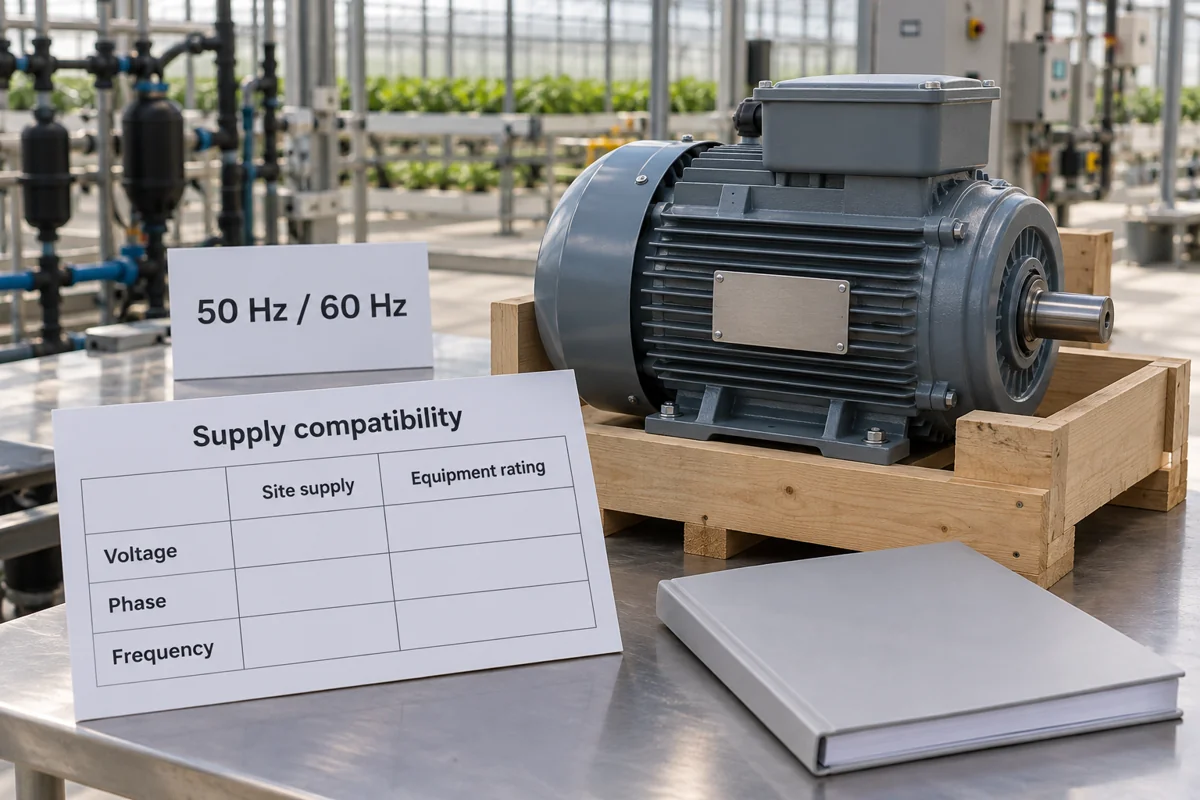
“50/60 Hz” on a quotation is a starting point for checking greenhouse equipment, not a complete release for shipment. Confirm the rating of the exact motor, drive and control assembly at the destination's voltage, phase and frequency. Then confirm that the assembly still meets the required equipment duty at that rating.
The check belongs before packing, while a wrong version can still be corrected at the factory. It should produce a written match between site-supply evidence, the shipped equipment identity and the manufacturer's approved operating data.
Read each rating as a complete set
A motor nameplate can contain several operating ratings. Keep the voltage, frequency, current, output power and speed associated with each rating together. Do not take the voltage from one line and assume the output shown elsewhere applies to it.
ABB's NEMA nameplate guide explains that frequency is tied to rated output, voltage and speed, and that a plate with more than one frequency must identify parameters that differ. Its explanation is useful for reading a plate; it is not approval to operate every motor on an alternative supply.
A greenhouse-specific example is the Viale Sistemi DVE2 product table, which lists separate 50 Hz and 60 Hz entries with associated electrical and mechanical data. Read the exact product row and obtain the manufacturer's current confirmation. A product-family page should not replace the data for the unit being shipped.
Keep a readable nameplate photograph and the relevant data sheet in the same equipment record. If a photograph omits an alternate-rating section, request another photograph rather than interpreting the missing information as approval.
Confirm the site supply without guessing from the country
Have qualified electrical personnel confirm the intended point of connection, supply voltage, phase and frequency. Record the document or measurement that establishes each value and the date. Identify a different backup supply separately if the equipment will use one.
A country name or plug appearance is insufficient information for an equipment order. A site can have more than one supply arrangement, and a machinery package may contain internal supplies that differ from the incoming service. The supplier needs the approved interface, not an assumption passed between purchasing teams.
Where the site supply is still provisional, show that clearly in the register. Ask who must confirm it and by which procurement decision. Do not let a provisional value become the factory's default simply because it was the only number available.
Check beyond the largest motor
List the items that make the package function: motor, variable-speed drive where used, starter or control components, transformer or power supply, control coils and supplied accessories. Ask the package manufacturer which ratings apply at each electrical interface.
A motor with an appropriate rating does not establish that every item in its control package has the same rating. Conversely, a broad input range on a control power supply does not establish motor compatibility. The review needs the complete assembly and its approved configuration.
If a variable-frequency drive is proposed, request written approval for the particular supply, drive, motor and load combination. ABB's guide distinguishes inverter-related application data from ordinary nameplate ratings. A drive is not a general permission to disregard equipment limits, and this checklist does not provide conversion or programming instructions.
Ask the equipment supplier to confirm the resulting operating duty. For a fan, pump or vent system, the required result is the approved machine performance under the stated conditions. A statement that the motor will turn leaves that question unanswered. Avoid applying a simple frequency ratio as a substitute for the manufacturer's review of the complete load.
Use a paired-rating shipment checklist
Download the voltage, phase and frequency checklist. Use one equipment ID per assembly, with separate rows for supported ratings and relevant components. Keep blank fields unresolved; do not fill them from a similar model.
| Check | Record | Evidence owner |
|---|---|---|
| Site interface | Connection point; confirmed voltage, phase and frequency; normal and backup source | Site electrical professional |
| Shipped identity | Equipment tag, model, serial or order code, and full nameplate photograph | Equipment supplier |
| Each supported rating | Linked voltage, frequency, current, power, speed and applicable duty data | Manufacturer |
| Controls and accessories | Component identities and approved supply ratings | Package and controls suppliers |
| Drive application | Written approval of the actual drive, motor and load combination, where relevant | Responsible manufacturers and designer |
| Machine duty | Confirmation that required equipment performance is met at the chosen rating | Equipment supplier |
| Release | Open deviations, approval reference, approver and date | Named project release authority |
Use the same equipment IDs in the greenhouse electrical load schedule. This article checks compatibility at the supply interface; the load schedule supports the wider facility design. Updating one without the other can leave purchasing and site teams working from different equipment data.
What should stop shipment?
Hold the affected item for review if the proposed unit cannot be identified, the applicable rating is absent, manufacturer and quotation data conflict, or the intended site supply remains unconfirmed. The same applies when a substitute is offered without a documented review of the complete assembly.
Classify the outcome as confirmed, approved change required, or unresolved. For an approved change, record the revised item, configuration and documents before release. Do not solve a mismatch by relabeling a plate, accepting a verbal tolerance claim or planning an improvised site modification.
After delivery, the qualified installation team should reconcile the received identities with the approved record before energization and perform the required commissioning. The shipment review reduces an avoidable procurement uncertainty; it does not replace local electrical approval or safe installation.
Keep the manufacturer's response beside the photographs and final schedule. When someone later asks whether a greenhouse motor can run on 50 Hz or 60 Hz, the answer should come from that exact assembly's approved record.