
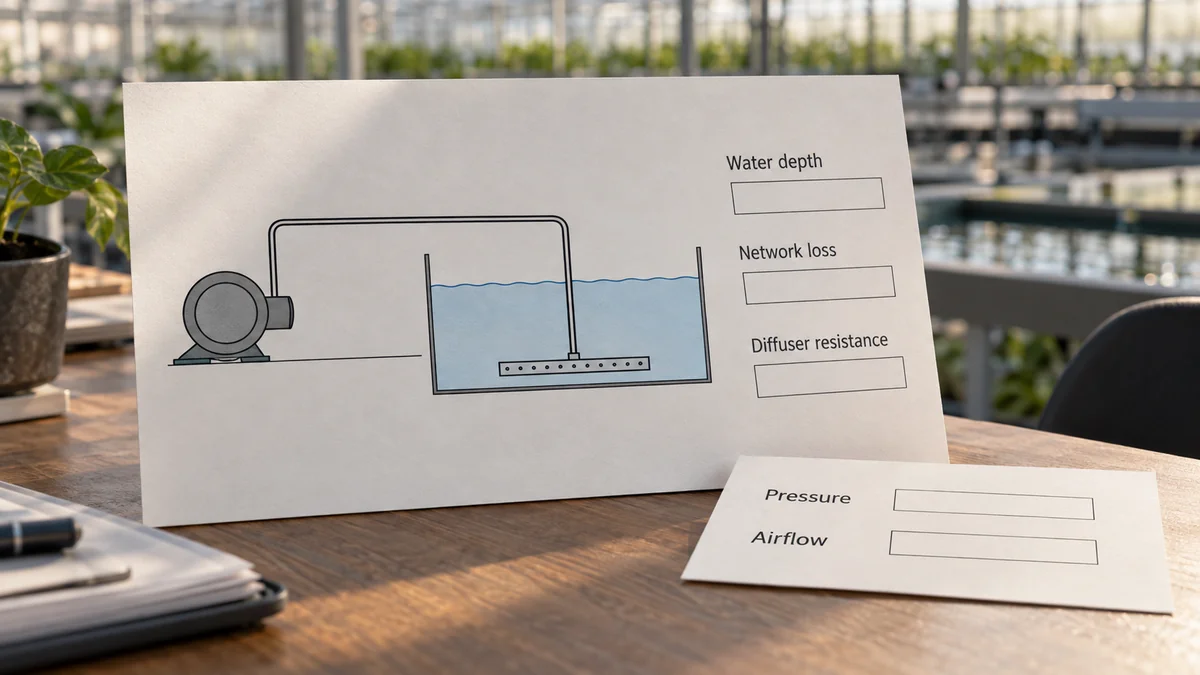
A blower quotation that gives only a large airflow number leaves the main purchasing question unanswered: how much air will reach the diffusers at the pressure the system requires? A free-air figure does not describe a blower working against water depth, a distribution network and diffuser resistance.
For a commercial deep-water culture system, ask the designer to define the required air duty first. Then compare suppliers at that duty, including the agreed difficult operating cases. Keep the crop's oxygen-performance requirement as a separate acceptance question.
Start at the diffuser, not at the motor label
Alabama Extension's greenhouse lettuce guidance describes regenerative blowers supplying submerged diffusers. It also explains why diffuser depth affects the energy needed to deliver air. This is a relevant greenhouse application, but it does not make a generic air-per-liter rule suitable for every crop or bed.
Have the designer identify the diffuser model, number in service, permitted airflow per diffuser and minimum and maximum operating water levels. A plan showing “air stones” without a product specification leaves resistance and delivery unresolved. The header drawing must also show which zones may operate together.
The required total airflow should carry units and reference conditions. Two offers stated in liters per minute may use different temperature or pressure bases. Ask each supplier to state the basis and reconcile it with the design requirement before comparing the figures.
Build one pressure budget for each operating case
Pentair's aquaculture catalog, Tech Talk 82, describes the pressure requirement as the combination of diffuser submergence, piping loss and diffuser resistance. All terms must refer to the same operating airflow and use compatible pressure units.
For a deliberately hypothetical example, suppose the documented inputs were 24 inches of water for submergence, 4 inches of water for distribution loss and 12 inches of water for diffuser resistance. The resulting pressure budget would be 40 inches of water. These are illustrative inputs, not recommended depths, losses or allowances for a greenhouse.
Do not add resistance from every parallel diffuser as though the air passed through them in sequence. Ask the designer to calculate the relevant network path and distribution. Keep clean-diffuser and specified service-limit resistance separate; the latter must come from an agreed maintenance and design basis, not an invented percentage.
Read airflow at pressure
A manufacturer's pressure–flow curve, or its tabulated points, lets you test a quote against that budget. Find the required pressure, read the corresponding airflow for the exact model, then compare it with the required airflow on the same basis. Never select from the free-air endpoint alone.
For a sourced reading example checked on October 2, 2026, Pentair's Sweetwater product table lists S31-A at 21 CFM at 40 inches of water and 16 CFM at 50 inches of water. If an illustrative requirement were 20 CFM at 40 inches, the listed point would exceed that flow requirement. At 50 inches it would fall short. The 20 CFM requirement is invented for this comparison; the two published delivery points are manufacturer data.
This is a table-reading exercise, not approval of S31-A for a project. Obtain the current model- and frequency-specific curve, its reference conditions and the manufacturer's correction for the actual site. A motor's ability to operate at a frequency does not establish identical airflow there. A catalog duty ceiling also does not mean the required airflow remains available at that ceiling.
Use the sheet to expose a missing decision
Complete one sheet per proposed package. In the two case columns, identify the operating state and attach the calculation or product evidence. Add another sheet when more limiting states need review.
| Evidence or decision | Normal operating case | Agreed limiting case |
|---|---|---|
| Case ID, concurrent zones and drawing revision | ________ | ________ |
| Minimum/maximum operating water depth | ________ | ________ |
| Diffuser model, quantity and permitted airflow range | ________ | ________ |
| Required total airflow, units and reference conditions | ________ | ________ |
| Submergence pressure at the relevant diffuser path | ________ | ________ |
| Clean/service-limit diffuser resistance at that airflow | ________ | ________ |
| Header/branch losses and calculation reference | ________ | ________ |
| Total operating pressure and common units | ________ | ________ |
| Site altitude, air-temperature basis and correction evidence | ________ | ________ |
| Exact blower model, frequency and curve revision | ________ | ________ |
| Documented delivered airflow at this duty point | ________ | ________ |
| Continuous-duty pressure/thermal envelope and conditions | ________ | ________ |
| Separate oxygen-performance requirement and verification owner | ________ | ________ |
| Match / mismatch / hold; unresolved evidence and approver | ________ | ________ |
A blank resistance field is a hold, not zero. A point outside the published curve is unresolved, not permission to extend the line. If a quote uses a different diffuser, the supplier must revisit the whole duty comparison rather than substituting a similar-looking item.
Keep air delivery and oxygen performance distinct
Air passing through the machine is not the same measurement as oxygen reaching the crop's root zone. Ask for two explicit deliverables: an equipment selection supported at the stated air duty, and a crop/system oxygen-performance plan approved by the responsible specialist. Buying more nominal airflow does not close a missing biological design requirement.
Record the agreed commissioning evidence and who will review it. This sheet does not prescribe a dissolved-oxygen target, a sampling method or a fish-stocking limit. It also does not replace the project's separate failure-response design.
Resolve the mismatch before purchase
If a candidate misses a required point, return the documented duty to the supplier. A revised blower or distribution proposal needs a revised comparison. Do not attempt to prove capacity by blocking a discharge, restricting branches, changing electrical connections or creating an unapproved operating state.
A useful final quotation names the model, supported duty points, limits and remaining conditions. That gives the buyer a defensible equipment comparison and leaves the designer accountable for the requirements used to make it.
Download the working files
Use these CSV files with the instructions in this article.