
A button-mushroom climate quotation should identify the growing-room compost load and crop-stage assumptions, not just the floor area. Equal-sized rooms can contain different cultivation-bed areas, compost quantities and activity schedules. Without those inputs, an area-only offer leaves the biological contribution to the heating and cooling calculation unresolved.
Keep this a quotation-basis check for the stated Agaricus production method. Providing a bed layout and batch ledger does not size an air-handling unit, establish a safe compost loading rate or show that a general blackout greenhouse is suitable for the crop.
Separate floor area, bed area and compost quantity
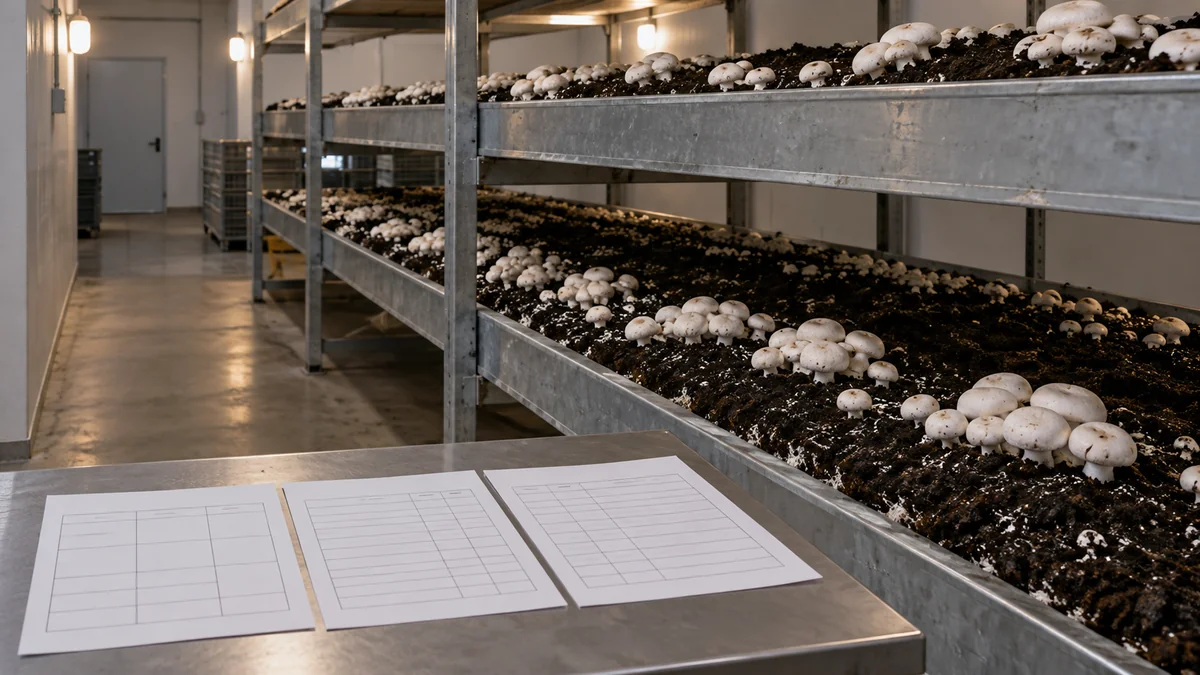
Room footprint describes the floor enclosed by the room. Cultivation-bed area describes the production surface across the specified beds and tiers. Loaded compost quantity is a material input with its own units and stated mass basis. These records are related, but one cannot silently stand in for the others.
Ask the supplier to show which record enters which part of the calculation. Retain the layout revision, bed configuration and compost-loading document used. If the quantity is described on an unclear wet, dry or other basis, ask the crop specialist to clarify it before comparing the offers.
A 2020 study by Beghi and colleagues examined a commercial white button-mushroom production cycle in Italy. Its account identifies the cultivation-bed arrangement and compost/mycelium contribution to changing thermal demand. This supports asking for biological-load evidence in a quotation. Its site and cycle results are not a sizing rule for another operation.
The study's calculation boundaries also matter: its treatment of envelope exchange and energy-consuming components belongs to that study. Do not carry its energy percentages, per-area or per-mass results into a different room, and do not scale its equipment from the floor area of your project.
Crop stage belongs in the load case
Identify when the room is filled and the stages covered by the proposed operating schedule. The supplier should state the source and method used for the biological allowance in each relevant calculation case, with review by the responsible crop and engineering specialists.
The Agro-Projects mushroom-equipment offering describes supplementary cooling for situations involving very active compost after filling. This is practical manufacturer evidence that compost activity can be a design consideration. It is not a recommendation that every room needs that product or a method for choosing its capacity.
For a project with several rooms, retain the filling and crop-stage schedule across them. Ask which rooms are assumed to be active together when shared services are assessed. A single-room description does not show the assumptions behind a central-system quote.
| Input | Evidence to attach | Question for the calculation author |
|---|---|---|
| Room footprint and envelope | Room drawing, construction and local outdoor basis. | Which envelope and outside-air conditions are included? |
| Total cultivation-bed area and tiers | Actual bed-layout revision. | Does the model use the offered growing arrangement? |
| Loaded compost quantity | Quantity, units, mass basis and crop specialist's record. | Is the biological input based on that material quantity? |
| Crop stage and timing | Filling and stage schedule for the batch. | Which operating case governs each stated duty? |
| Simultaneously active rooms | Project batch schedule and shared-system boundary. | What overlap does the common service calculation assume? |
| Biological allowance | Source, method, assumptions and responsible specialist. | What is evidenced, assumed or still unresolved? |
Compare two offers before comparing capacities
Consider a hypothetical room for which two suppliers quote climate equipment. Supplier A bases its offer on room floor area and gives no bed or compost record. Supplier B names the stacked-bed layout, loaded compost quantity and a stage schedule, with a stated biological allowance awaiting specialist review.
B has a more traceable basis, but that alone does not approve its capacity. A needs to disclose its missing inputs. B needs the pending allowance review. The buyer should request the same agreed room and batch basis from both before treating their capacity or price differences as like-for-like.
In another hypothetical change, the room footprint stays the same while the proposed bed configuration and compost quantity change. Return that revision to the calculation author. Do not assume that the earlier quote remains valid or that the change can be represented by a simple linear multiplier.
These examples contain no recommended loading, equipment rating or production result. They show which change requires a revised engineering response.
Ask what the quotation includes
Keep the biological allowance separate from outside-air, envelope, equipment and moisture duties in the evidence request. Ask the designer to identify their treatment and any interactions in the calculation, so that an excluded contribution is not lost inside a single “room load” heading.
Also distinguish thermal load from structural load. A bed or support drawing accepted for weight does not establish the climate duty. Conversely, a thermal calculation is not permission to load a structure. Each belongs to the qualified discipline responsible for it.
If an offer relies on a cited study or previous project, request the conditions that make the reference relevant and the differences accounted for. A matching crop name is only the beginning of that comparison.
Give every assumption a visible owner
The room and batch load-basis ledger is a manual worksheet, not a capacity calculator. Use one copy for the named room/batch case, then identify the simultaneous-room schedule where services are shared.
For each input, distinguish buyer-supplied information, a supplier assumption, supporting evidence and an unresolved question. Record the responsible reviewer and calculation reference rather than assigning an automatic pass.
Send the completed ledger and its drawings back with the RFQ. Ask each supplier to return a quotation on the agreed basis, with exclusions and pending approvals stated. That gives the project team a comparable engineered proposal to review without pretending that floor area alone defines the mushroom room.